AI is moving beyond workplace productivity and adult design software into a new consumer category: AI-assisted creativity for children and families. The most meaningful version may not keep kids inside a screen — it may help them make something they can hold.
Artificial intelligence is quickly moving beyond workplace productivity, professional design tools, and adult creative software. A new consumer category is starting to emerge: AI-assisted creativity for children and families.
For parents, educators, and consumer-technology companies, the question is no longer only whether children should use digital tools. The more important question is what those tools help children do. Do they only keep children inside a screen — or do they help children create something meaningful outside of it?
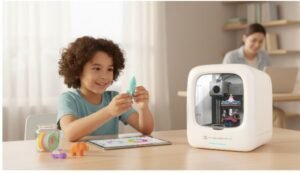
That is where AI-assisted toy design and kid-friendly 3D printing are beginning to stand out. When used thoughtfully, AI can help children move past the blank-page problem, guided design tools can help shape an idea, and 3D printing can turn that idea into a physical object. Instead of ending with another digital file, children can make something they can hold, play with, gift, test, and improve. AOSEED JOY AI is one example of this shift — connecting AI-assisted modeling, game-style toy customization, a large toy library, and family-friendly 3D printing to help children move from imagination to printable toys.
Why children’s creative tech needs more than another app
Many children’s apps are designed around digital interaction. Kids can tap, color, swipe, customize, or generate something on a screen. These experiences can be entertaining and sometimes educational, but they often end where they begin: inside the device. The output may be a saved image, a completed level, or a digital avatar — and once the app is closed, the activity often ends with it.
Parents are increasingly looking for a different type of technology experience — tools that encourage children to make, build, and use imagination in ways that extend beyond passive screen time. This does not mean every creative tool must avoid screens completely. The screen can help a child choose a model, customize a design, or follow guided steps. The key difference is whether the screen is the destination or the starting point. AI-assisted 3D printing offers a more active path: a child can begin with a digital idea, shape it through a guided tool, print the object, and then use it in real life.
The new creator-tech loop: idea, design, print, play
The strongest children’s creative technology is not just about generating content. It is about helping children move through a complete creative loop:
Idea
- A child imagines a toy, vehicle, creature, or gift.
- Encourages curiosity and creative thinking.
- The starting point of the entire creation process.
Design
- AI-assisted tools and guided customization help shape the idea.
- Transforms imagination into a workable design.
- Reduces the blank-screen barrier and makes creation easier.
- The digital model becomes a physical object.
- Turns ideas into something tangible and real.
- Bridges the gap between digital creativity and the physical world.
Play
- The object becomes a toy, game piece, gift, or prop.
- Allows children to interact with their own creations.
- Extends value beyond printing through play and exploration.
Improve
- The child modifies, refines, or expands the next version.
- Encourages experimentation and problem-solving.
- Introduces the concept of iteration and continuous improvement.
This is where creativity becomes repeatable. The first object is not the end of the activity — it becomes the beginning of the next idea.
How AI-assisted toy design lowers the starting barrier
For many children, the hardest part of making something is not imagination. It is starting. A child may have plenty of ideas but still struggle with a blank screen. Traditional 3D design tools can feel too advanced for young users and first-time families, often requiring technical knowledge and spatial thinking before the user can create something satisfying.
AI-assisted toy design can help lower that barrier. The best use of AI in children’s creativity is not to do everything for the child — it is to help the child begin, offering prompts and suggesting creative directions so the first step feels less intimidating. From there, game-style customization makes design feel more playful: children choose shapes, themes, colors, or simple details without needing advanced CAD tools. Then beginner-friendly 3D modeling gives older or more confident children room to grow, moving from basic customization into structural builds and more custom projects.
With AOSEED JOY AI’s kid-friendly modeling experience, children can begin with AI-assisted prompts, explore game-style toy customization, and move toward printable objects without starting from a blank professional design screen. The point is not to replace imagination — it is to give imagination a clearer path into action.
Why physical output makes AI creativity more meaningful
AI-generated content can be impressive, but much of it remains digital. A generated image may be saved; a chatbot idea may be read; a digital avatar may be customized. For children, the experience can become more meaningful when the output enters the real world. 3D printing gives AI-assisted creativity a physical endpoint.
The difference between an AI-generated idea and a printed toy is simple: one is viewed, the other is used. A printed toy can be held. A small vehicle can be raced. A creature can become part of a story. A game token can join family game night. A custom object can decorate a desk. A personalized design can become a gift. That physical output also creates real-world feedback — if a toy car does not roll well, the child can think about the wheels; if a printed character cannot stand, the child can think about balance. The child makes something, observes it, and considers how it could be improved.
The Toy Library as a repeat-use engine
One common challenge with children’s technology products is long-term use. Many products are exciting when first opened but slowly lose attention after the first few days. That is why a toy library matters.
A large project library gives children and parents a reason to return. Instead of starting from scratch every weekend, families can choose from a wide range of printable ideas — animals, vehicles, game pieces, gifts, decorations, pretend-play props, and small creative projects. For children, this creates a sense of possibility: there is always another model to try. For parents, it reduces planning friction. A 5,000+ toy library helps turn JOY AI from a one-time product into a repeat-use family creativity platform, where each project creates the next prompt.
Family-friendly hardware still matters
AI software and creative apps are important, but for a product used by families, hardware design still matters. Parents care about whether a product feels manageable at home, whether it is approachable for beginners, and whether children can participate meaningfully without the entire process becoming too technical.
JOY AI is designed around home creativity and parent-supported use. Its family-friendly features include a rounded-corner design, a fully enclosed structure, quiet printing, and a guided app workflow. It also supports fast printing speeds of up to 400 mm/s, helping reduce the time between a child’s idea and the finished object. These details matter because children’s creative products need to work in real homes, not only in hobbyist workshops. A parent does not need to become a 3D printing expert before helping a child begin — the child makes creative choices while the parent supports setup, supervision, and troubleshooting.
What kids can actually make
The strongest case for AI-assisted toy design becomes clear when looking at what children can actually create:
Toy Animals
- Dinosaurs
- Pets
- Fantasy creatures
- Great for storytelling and imaginative play
Vehicles
- Mini cars
- Racers
- Small trucks
- Ideal for testing, racing, and active play
Game Pieces
- Tokens
- Score markers
- Dice trays
- Perfect for family game nights and board games
Gifts
- Keychains
- Name tags
- Ornaments
- Adds emotional and personal value
Decorations
- Room signs
- Desk pieces
- Shelf items
- Helps children personalize and take ownership of their space
Learning Objects
- Shapes
- Models
- Small structures
- Supports hands-on learning and exploration
- Encourages creativity and problem-solving skills
The value is not only that these objects can be printed. It is that they become part of play, learning, gifting, and family activity.
Why this matters for the children’s tech market
Children’s technology is often criticized for encouraging passive consumption. But the next generation of creative products may offer a different direction. AI-assisted toy design and kid-friendly 3D printing suggest a more hybrid model: software, AI, hardware, project libraries, and physical play working together.
This is important for the consumer-technology market because the most successful children’s products may not be single-use gadgets. They may be ecosystems that help children keep creating over time. A standalone app can entertain. A standalone printer can produce objects. But a connected system can help a child move from idea to finished project, then return for another round of making.
This is where AOSEED’s family creativity ecosystem fits into a broader creator-tech trend. The company is positioning JOY AI not just as a printer, but as a family-friendly system for toy-making, guided design, learning support, and repeatable creative projects. The larger category opportunity is clear: parents want technology that feels more meaningful, children want tools that make ideas feel real, and AI-assisted design can help bridge the gap between imagination and action.
Seasonal timing and family use cases
Timing also matters. A product like JOY AI can work as a gift, but it can also become a fun project tool — children can print toys, game pieces, decorations, and small learning objects throughout the season.
This gives the product a longer use window than a single holiday, supporting weekend projects, rainy-day activities, and personalized gift-making. It is the product’s ability to turn creative ideas into physical projects children can continue using.
AI toy design becomes more powerful when kids can hold the result
AI-assisted creativity becomes more meaningful when it leads to physical making. For children, the act of printing a toy, using it, testing it, gifting it, or changing it gives technology a clearer purpose. It helps them see that digital ideas can become real objects — and that those objects can be improved over time.
That is the core value of AI-assisted toy design. It is not about AI doing all the work; it is about helping children start, customize, print, play, and keep creating. The future of children’s creative technology may not be only more apps or more screens. It may be systems that connect software, AI, hardware, project libraries, and hands-on play. AOSEED JOY AI represents one example of that shift: a product designed to help children move from ideas to printable objects, and from printable objects to meaningful play.
Source: FG Newswire