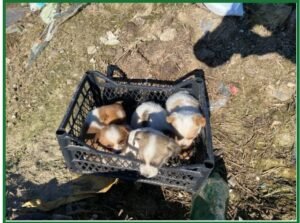
Abandonment is not just an unfortunate situation for an animal that suddenly has to fend for itself: to find food, to protect itself, and to struggle to survive in a world shaped by humans according to their own needs.
An abandonment is, first and foremost, a broken heart—that of a dog who believed it was part of a family.
We see this every day. And while we treat their wounds, feed them, and offer them safety, we know that we can do very little to erase the sadness of being abandoned by the people they loved.
We understand this because we see each case individually, each animal with its own needs. Numbers are just summaries at the end of the day or month. Unfortunately, they also tell a sad story: too many animals continue to be abandoned.
It is true: the problem is not as widespread as it was 30 years ago. But ROLDA still hopes and fights for something better.
The problem of abandonment in Romania
The 1990s that made us known
“A village without dogs” is a Romanian expression used to describe a lack of authority and protection. Ironically, it perfectly described Romania in the 1990s, with packs of stray dogs roaming the streets of cities.
Preoccupied with the internal political crisis, neither the country’s leadership nor local administrations paid attention to animals that belonged to no one. Unspayed and unneutered, they multiplied uncontrollably.
To this situation was added constant abandonment: aging animals, unwanted puppies, or pets that owners no longer wished to care for. The number of those left to fend for themselves grew rapidly. In Bucharest alone, it was estimated that around 100,000 stray dogs were present.
The first reactions of the authorities
Seeing the situation strictly as an administrative issue, without empathy, authorities approached it brutally. Euthanasia became the main method, with tens of thousands of dogs killed in the first campaigns meant to “clean” the streets.
Things became even worse when lack of funding led to inhumane practices. In some cases, the methods used by dog catchers and public shelters exceeded all limits.
These situations attracted international media attention and mobilized the first animal protection initiatives. In a civil society that was just beginning to take shape, organizations started to form and gain a voice.
ROLDA’s first steps
ROLDA began its activity in the early 2000s, when rescuing animals from extreme situations became a mission for its founder, Dana Costin.
Galați, her hometown, was facing the same severe problem. On the grounds of the former steel plant, approximately 10,000 dogs had gathered, living in semi-wild conditions in an area that people had started to avoid.
When authorities decided to intervene, ROLDA became a humane alternative to quick and brutal solutions: euthanasia or underfunded public shelters where animals were left to die. Moreover, in the absence of real preventive measures, such as penalizing abandonment and promoting sterilization, the problem continued to worsen.
Despite this, thousands of dogs were rescued, treated, rehabilitated, and adopted through ROLDA. Those who could not be adopted found a permanent home within the organization’s shelter, without being condemned to death.
How does ROLDA address the problem of abandonment?
Twenty years have passed since ROLDA became a benchmark in rescuing stray animals.
The shelters in Smârdan, Galați County, are built to European standards. The organization benefits from international support, and the results achieved by a small but dedicated team are remarkable.
Abandonment – Still a current issue
Between 2008 and 2015, ROLDA managed to reduce the number of stray dogs on the steel plant grounds in Galați from 10,000 to 1,000. All this without resorting to euthanasia and without giving up on any animal taken into care.
It was a period of growth, sometimes forced in order to take in as many animals as possible—a time when we expanded our range of skills and learned to do almost everything humanly possible on our own, to find solutions and partners who could take on what we could not accomplish, and above all, to find resources and carefully allocate them to meet as many of our residents’ needs as possible.
After this effort, requests came from across the entire county. Although legislation improved, abandonment did not disappear. It is less visible than it was 20 years ago, but it still continues to endanger lives.
Current issues related to abandonment
Today’s laws make many people think twice before abandoning their animals. However, those who still choose to do so find increasingly hidden ways.
Some abandon animals in isolated areas where they won’t be seen, leaving poor dogs in unfamiliar places, often alongside other animals they must compete with for resources, in areas heavily trafficked by fast-moving vehicles, or in unsafe environments.
In some cases, people contact us directly to take unwanted animals. These situations are not ideal, but they are still preferable to abandonment in fields or dangerous locations. For us—and especially for the animals—it is better for them to be taken in safely than to be found injured on the roadside.
How do we prevent abandonment?
Any problem has two components: cause and effect. The effects are visible. The causes, however, must be understood.
Some people abandon their animals because they do not know they should do better, or that this act is punishable. Here, the role of authorities is essential.
Beyond that, ROLDA intervenes through social and educational programs. The most receptive people are those looking for solutions to keep their animals but who struggle to afford their care. This is where we step in, supporting those who want to keep their pets but cannot cover the costs. We provide food and assistance, which prevents abandonment and keeps animals within their families.
Sterilization campaigns are also well received by communities, especially in areas where people cannot afford to care for unwanted litters. ROLDA funds numerous such campaigns, helping keep the number of stray animals in Galați County as low as possible.
Educational programs, aimed at both adults and children, help change mentalities: how to care for an animal, what responsibilities come with it, and where to seek help.
There are still abandoned animals—animals we rescue from the streets, suffering, abused, undernourished. But we do not lose hope, and we know for certain that through every measure we take, we have reduced the suffering of these poor souls as much as we could.
The road to completely eliminating abandonment is long, but we continue, step by step.
Source: FG Newswire