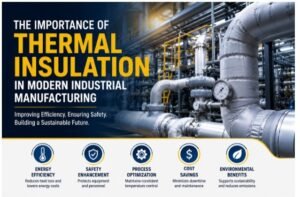
Walk through almost any industrial facility — a furnace line, a power plant, a chemical processing unit — and you’ll find insulation doing quiet, unglamorous work behind the scenes. It rarely gets the attention that production equipment does, but it directly affects three things every manufacturer cares about: energy costs, worker safety, and equipment lifespan. As energy prices remain volatile and industrial safety standards tighten, thermal insulation has moved from a background consideration to a genuine engineering priority.
This article looks at why thermal insulation matters so much in modern manufacturing, what materials are commonly used, and how facilities are approaching insulation decisions today.
What Thermal Insulation Actually Does
At its core, Thermal Insulation slows the transfer of heat between a hot process and its surroundings, or in some cases, keeps external heat from affecting temperature-sensitive processes. In industrial settings, that translates into a few specific functions:
- Reducing heat loss from furnaces, kilns, boilers, and pipework, which keeps process temperatures stable and reduces the energy needed to maintain them.
- Protecting workers from surfaces that would otherwise reach dangerous temperatures.
- Protecting equipment and structures from thermal stress, which can cause warping, fatigue, or premature failure in metal components exposed to repeated heating and cooling cycles.
- Maintaining process consistency, since temperature fluctuations in manufacturing environments like glass production, metal casting, or chemical processing can directly affect product quality.
None of these functions are optional extras — they’re part of what makes high-temperature industrial processes viable and safe to run continuously.
The Energy Case for Insulation
Energy costs are one of the largest ongoing expenses in industries that rely on furnaces, kilns, dryers, or boilers. Poorly insulated equipment loses heat continuously, which means more fuel or electricity is required just to maintain a target temperature. Over months and years of continuous operation, that inefficiency compounds into a significant cost.
Well-designed insulation systems address this in a few ways:
- Lower fuel and electricity consumption, since less energy escapes through walls, doors, and seals.
- Faster heat-up times, because insulated systems retain heat rather than losing it to the surrounding environment, meaning equipment reaches operating temperature more quickly after startup.
- More stable internal temperatures, reducing the energy spikes needed to compensate for heat loss during operation.
For facilities running energy-intensive processes around the clock, insulation upgrades are often one of the more cost-effective efficiency investments available, frequently paying for themselves through reduced utility costs within a few years.
Worker Safety and Regulatory Compliance
Beyond energy, thermal insulation plays a direct role in workplace safety. Uninsulated or poorly insulated equipment surfaces can reach temperatures well beyond what’s safe for incidental contact, creating burn hazards for anyone working nearby. Insulation reduces surface temperatures to safer levels, and in many jurisdictions, meeting specific surface temperature limits is a regulatory requirement rather than a voluntary best practice.
Insulation also contributes to fire protection in some applications, since certain insulation materials are used specifically as fire-resistant barriers around equipment, cabling, and structural elements exposed to high heat.
Protecting Equipment from Thermal Stress
Repeated heating and cooling cycles put mechanical stress on industrial equipment, particularly metal components that expand and contract with temperature changes. Without adequate insulation, this thermal cycling happens more abruptly and more severely, accelerating wear on furnace shells, pipework, and structural supports.
Proper insulation smooths out these temperature swings, which reduces mechanical stress and extends the operational life of expensive equipment. For facilities running furnaces or kilns that represent significant capital investment, insulation is as much an asset-protection measure as it is an energy-efficiency one.
Common Industrial Insulation Materials
Different applications call for different insulation materials, largely based on the temperature range involved and the specific mechanical or chemical conditions of the environment.
Mineral Wool and Fiberglass
Common in lower-to-moderate temperature applications, these materials are widely used for pipe insulation, ductwork, and general building insulation within industrial facilities.
Calcium Silicate
Used in higher-temperature piping and equipment applications where rigidity and compressive strength matter, particularly in petrochemical and power generation settings.
Ceramic Fiber
For the highest-temperature applications — furnace linings, kiln walls, boiler insulation — Ceramic Fiber is one of the most widely used materials in industrial manufacturing. It’s valued for a specific combination of properties: it’s lightweight, resistant to thermal shock, and capable of withstanding sustained temperatures well beyond what most other insulation materials can handle, with some grades rated for continuous use above 1,200°C.
Ceramic fiber is available in several forms depending on the application:
- Blanket — flexible and easy to install around irregular shapes, commonly used for furnace and kiln linings.
- Board — rigid panels used where structural support alongside insulation is needed.
- Module — pre-compressed blocks designed for faster furnace lining installation and consistent long-term performance.
- Paper and mixes/coatings — used for gaskets, seals, and repair or touch-up applications on existing furnace linings.
Because of its low heat storage, ceramic fiber also cools down relatively quickly compared to denser refractory materials, which matters for equipment that cycles frequently between hot and cold states rather than running continuously.
How Manufacturers Are Approaching Insulation Decisions Today
Insulation selection has become more deliberate over the past decade, driven by a few converging trends:
- Rising energy costs, which have made the payback period on insulation upgrades shorter and more attractive.
- Tighter safety regulations, particularly around surface temperature limits and fire protection standards.
- Sustainability targets, with many manufacturers under pressure to reduce overall energy consumption and emissions, making insulation efficiency part of broader environmental goals.
- Material advancements, including bio-soluble fiber alternatives that maintain high-temperature performance while addressing some of the handling and health concerns associated with older insulation materials.
Rather than treating insulation as a one-time installation decision, more facilities now review and upgrade insulation systems periodically, particularly for equipment that’s been in continuous service for years and may be losing efficiency as materials degrade.
Questions to Ask When Evaluating Industrial Insulation
For facilities assessing their current insulation setup, a few practical questions tend to surface the most useful information:
- What’s the actual operating temperature range, and is the current insulation rated appropriately for it?
- Are there measurable surface hot spots suggesting insulation has degraded or was installed incorrectly?
- Has energy consumption for a given process increased over time without a corresponding change in output?
- Does current insulation meet current safety and fire protection standards, or was it installed under older requirements?
Answering these honestly often reveals whether an insulation upgrade would pay for itself faster than expected.
Conclusion
Thermal insulation doesn’t get much visibility in industrial manufacturing, but its impact touches nearly every part of a facility’s operation — energy bills, worker safety, equipment longevity, and process consistency. As energy costs and safety standards continue to shift, insulation decisions deserve more attention than they typically get. Whether it’s mineral wool for moderate-temperature piping or ceramic fiber for the highest-heat furnace applications, choosing the right material for the actual operating conditions is one of the more straightforward ways manufacturers can cut costs and reduce risk without touching core production processes at all.
Source: FG Newswire