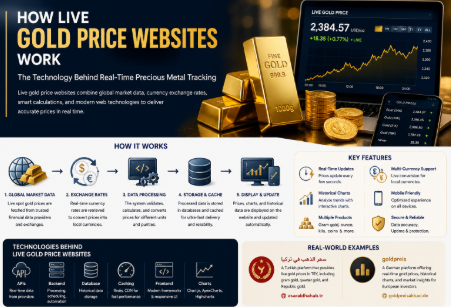
Every second, thousands of investors around the world check live gold prices before buying jewelry, investing in bullion, or monitoring financial markets. What appears to be a simple number on a website is actually the result of multiple systems working together—from international commodity exchanges and currency conversion APIs to caching servers and interactive charting libraries.
Modern gold price platforms don’t simply display market data. They collect information from trusted financial sources, convert it into local currencies, calculate country-specific gold products, and present everything through fast, user-friendly interfaces. Understanding how these systems work provides valuable insight into the technology powering today’s financial websites.
Why Localized Gold Prices Matter
The international spot price of gold is generally quoted in U.S. dollars per troy ounce, but this format isn’t particularly useful for most consumers.
A jewelry buyer in Istanbul is unlikely to think in terms of troy ounces or U.S. dollars. Instead, they want to know the current value of gram gold, quarter gold, Republic gold, or 22-karat jewelry in Turkish Lira.
This is where localization becomes essential. Financial websites that provide gold price (like www.asaraldhahab.tr for Turkey market) transform global commodity prices into information that matches local buying habits. Behind the scenes, these platforms continuously combine international spot prices with current USD/TRY exchange rates and country-specific calculations to deliver prices that are immediately useful to Turkish investors.
Instead of manually performing these conversions, users receive accurate local prices that update automatically as the market changes.
Where Live Gold Price Data Comes From?
Modern gold price websites depend on multiple data providers rather than a single source.
Typical information includes:
- International spot gold prices
- Currency exchange rates
- Historical market data
- Trading session updates
- Precious metal benchmarks
Most providers expose this information through REST APIs that return structured JSON data, allowing websites to process new prices automatically every few minutes—or even faster, depending on the service.
Processing Market Data
After receiving fresh market information, the backend performs several calculations before displaying anything to visitors.
A simplified workflow looks like this:
- Retrieve the international spot price.
- Validate the incoming market data.
- Fetch the latest currency exchange rates.
- Convert prices into the target currency.
- Calculate values for local gold products.
- Store historical values.
- Refresh charts and price tables.
This automated pipeline allows websites to deliver consistent information without requiring manual updates.
Calculating Country-Specific Gold Products
Different countries trade different forms of gold.
For example:
Turkey
- Gram Gold
- Quarter Gold
- Half Gold
- Republic Gold
Germany
- Gold per gram
- Gold per ounce
- Gold per kilogram
- Investment bullion
Each product requires additional calculations based on purity, weight, and current exchange rates.
Building Fast Gold Price Websites
Financial data changes constantly, making website performance just as important as data accuracy.
Developers commonly use:
- Redis
- Server-side caching
- CDN caching
- Scheduled background jobs
- API rate limiting
Without these optimizations, every visitor would trigger expensive external API requests, slowing down the website and increasing infrastructure costs.
Visualizing Market Trends
Current prices tell only part of the story.
Investors also want historical performance, daily movements, and long-term trends.
Interactive charts built with libraries such as Chart.js, ApexCharts, or Highcharts make this possible by transforming raw numerical data into visual insights.
A well-designed platform doesn’t simply display numbers—it helps users understand how the market is moving over time.
Delivering a Better User Experience
Technical accuracy alone isn’t enough.
Successful financial websites also prioritize usability.
This includes:
- Responsive layouts
- Fast loading times
- Mobile-friendly interfaces
- Accessible typography
- Clean data visualization
- Intuitive navigation
These elements ensure visitors can quickly find the information they need, regardless of the device they’re using.
A good example of this approach can be seen on www.goldpreisaktuel.de, where real-time market data is combined with historical charts and localized pricing for German-speaking users. Although the target audience differs from Turkish investors, the underlying technologies—API integration, currency conversion, caching, and responsive visualization—follow the same principles used by financial platforms worldwide.
The Future of Gold Price Platforms
As financial technology continues to evolve, gold price websites are becoming much more than simple price trackers.
Emerging innovations include:
- AI-generated market summaries
- Personalized price alerts
- Predictive analytics
- Interactive investment dashboards
- Portfolio management tools
- Voice-assisted market updates
These features are transforming traditional gold price websites into comprehensive financial information platforms.
Conclusion
Behind every live gold price website is a sophisticated technology stack that continuously gathers market data, converts currencies, performs localized calculations, and delivers results within seconds. What users experience as a simple price table is actually powered by APIs, backend automation, caching systems, databases, and modern web technologies.
Whether serving investors in Turkey, Germany, or any other market, the goal remains the same: transforming complex financial data into accurate, reliable, and easy-to-understand information.
Source: FG Newswire