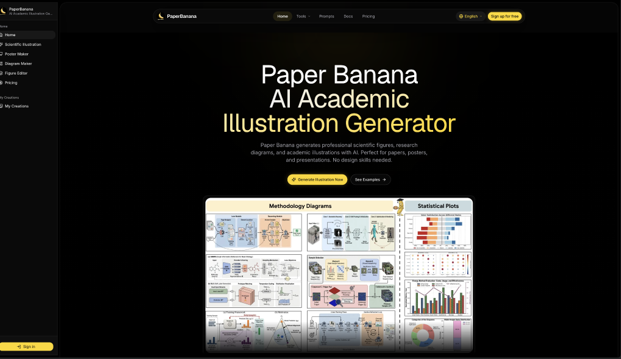
Paper Banana has introduced an AI academic illustration tool designed to help researchers, students, and educators create clearer scientific figures from complex academic content.
Scientific communication is becoming increasingly visual. Research papers, conference posters, classroom materials, grant proposals, online courses, and slide decks all depend on clear figures to explain complex ideas. A well-designed figure can help readers understand a research method, a workflow, a biological mechanism, a technical process, or a conceptual model much faster than text alone.
Why Scientific Figure Creation Still Takes Time
For many academic users, however, creating these visuals is still a time-consuming process.
Researchers often understand their work deeply, but turning that understanding into a clean scientific figure can be difficult. A methods section may describe several steps in detail, but the visual structure is not always obvious. A research note may contain the right information, but it still needs to be organized into boxes, arrows, labels, and logical sections. A classroom concept may be clear to the teacher, but students may need a diagram before the idea becomes easy to follow.
This gap between academic understanding and visual explanation is the problem Paper Banana aims to address.
From Academic Content to Visual Drafts
Tools such as paper banana are part of a growing category of AI products focused on academic visualization and research productivity. The goal is to help users move faster from dense academic content to structured visual drafts that can be reviewed, edited, and refined.
Scientific figures are different from general images. A scientific figure needs to be accurate, readable, and useful in a real academic workflow. It must show the correct sequence, use appropriate labels, and communicate the relationship between concepts clearly. A visually attractive image has limited value if it misrepresents the science.
Why Human Review Matters
This is why AI academic illustration tools need to support human review.
Paper Banana is built around the idea that AI can help create the first visual draft, while the researcher, student, or educator remains responsible for checking the meaning and improving the final result. AI can suggest a visual structure, but the human user verifies the accuracy. AI can organize a first draft, but the user decides whether the labels, flow, and relationships are correct.
This human-in-the-loop approach is especially important in academic work, where clarity and correctness both matter.
Use Cases for Students, Researchers, and Educators
The tool can support a range of use cases. Graduate students may use it to create visual drafts for lab reports, thesis chapters, or research posters. Researchers may use it to summarize methods, mechanisms, and workflows for papers or presentations. Educators may use it to turn abstract topics into diagrams for teaching materials. Data science and computer science teams may use it to visualize pipelines, system architectures, model workflows, or analytical processes.
In each case, the value is the same: complex information becomes easier to understand.
Figures Can Improve Research Thinking
Figure creation can also improve the thinking process itself. When a researcher turns an idea into a diagram, missing steps and unclear relationships often become easier to notice. A crowded figure may reveal that the explanation needs to be simplified. A vague label may show that a concept needs clearer wording. A confusing layout may expose a weak structure in the research story.
In this way, scientific figure creation is not only a presentation task. It can also help researchers clarify their own ideas.
The Growing Need for Academic Visuals
The demand for better academic visuals is growing across many fields. Life science researchers often need to explain mechanisms, pathways, and experimental workflows. Data scientists need to communicate data pipelines, models, and evaluation processes. Educators need visual materials that help students understand complex concepts. Interdisciplinary teams need diagrams that make collaboration easier between people with different backgrounds.
At the same time, academic communication is expanding beyond traditional papers. Research is now shared through preprints, online courses, lab websites, slide decks, social media, conference posters, and digital learning platforms. This creates more demand for visuals that are clear, reusable, and easy to adapt.
A More Visual Future for Research Communication
Paper Banana’s launch reflects this broader shift toward AI-assisted research communication. The tool is intended to reduce the manual friction of creating early-stage scientific figure drafts, while keeping expert review at the center of the workflow.
As AI continues to enter academic and educational workflows, tools focused on scientific visualization may become an important part of how complex ideas are communicated. The goal is not to replace scientific thinking. The goal is to help researchers, students, and educators explain what they already understand more clearly.
Better scientific figures can make academic work easier to read, easier to present, and easier to share. For teams working with complex research, that clarity can make a meaningful difference.
Source: FG Newswire