Small-Scale Forestry in the Netherlands
Woodland in the Netherlands is largely managed in small parcels, by private owners, estates, and nature organisations. Thinning, storm cleanup, and firewood cutting all produce felled timber that must be moved to a track or landing. In a densely used landscape, moving logs without heavy forwarders or excessive ground damage is a practical concern. A skidding winch mounted on the three-point hitch of a tractor lets a mid-size machine extract logs in a controlled way.
How a Skidding Winch Works
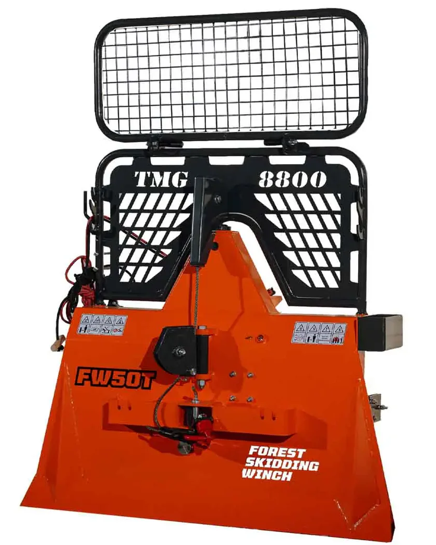
A skidding winch is an attachment carried on the three-point hitch at the rear of a tractor. It contains a drum wound with steel cable, driven from the tractor. The operator pulls the cable out to a felled log, secures it with a choker chain, and the winch then winds the cable in, dragging the log across the ground to the tractor. A blade or butt plate at the base braces the winch and lifts the front of the log slightly, which reduces the resistance of dragging.
This allows one operator and one tractor to recover timber that would otherwise require larger and more costly machinery.
Why It Suits the Local Landscape
For the scale of forestry common in the region, a tractor winch offers clear advantages:
- It uses a tractor the owner already has, rather than a dedicated forwarder
- It allows the tractor to stay on firm ground while the cable reaches into softer stands
- It limits the soil compaction and rutting that heavy machinery causes
Safety Practices
A loaded steel cable stores significant energy, and a cable that fails or a choker that slips can recoil with great force. Safety practices are not optional:
- Keep all bystanders well outside the working area and never in line with the cable
- Inspect the cable for kinks, broken strands, and wear before each use
- Use rated chokers and attachment points rather than improvised hooks
- Set the tractor brake and lower the winch blade to anchor the machine before pulling
- Match the winch to a tractor within its stated horsepower range
Performance and Maintenance
The condition of the cable and the winch brake determines both safety and effectiveness. A frayed cable should be replaced, not used until it breaks, and the drum brake must hold the load reliably. Matching the winch to a tractor of suitable weight and power keeps the machine stable, since an undersized tractor can be pulled backward or tipped by a heavy log. Routine greasing and storage under cover prevent corrosion of the cable and the mechanism.
Strengths, Trade-offs, and Practical Use
A tractor skidding winch is efficient and far less costly than dedicated forestry machinery, though it requires a suitable tractor and careful technique. For example, an estate owner thinning a stand can recover firewood and timber through the winter without bringing contractors and large equipment onto soft ground. The trade-off is that skidding drags logs along the surface, which suits prepared extraction routes.
Conclusion
A skidding winch turns an existing tractor into a capable timber-extraction tool for small-scale forestry. Matched to the tractor, operated with strict attention to cable safety, and maintained against corrosion, it supports woodland management efficiently and at modest cost.
Source: FG Newswire