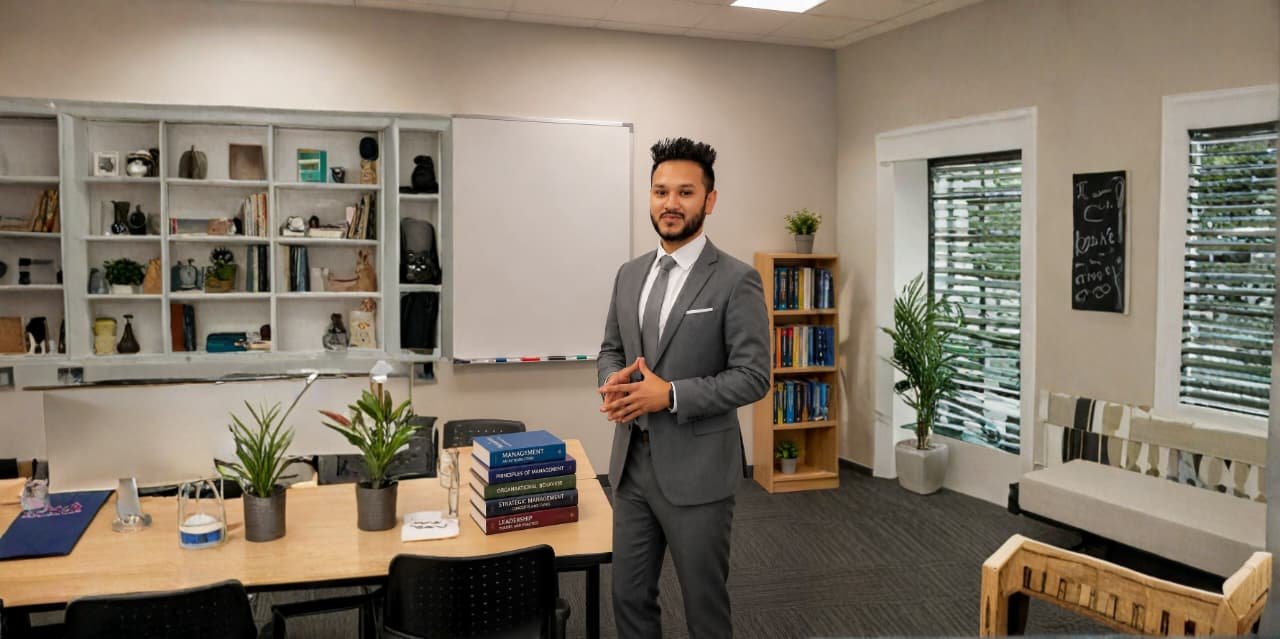
Tanmay Dilip Mendhey takes a diverse view of hospitality as a field of study and one of his greater interests. He has a degree in Hotel Management and a postgraduate specialisation in Hospitality Management. He is passionate about not only how to deliver superior service to guests but also how to make guest experiences more flexible, inclusive, and responsive to the evolving trends of the industry. He has always thought about hospitality, not limited to an operational perspective but considering how the systems behind those experiences can be enhanced via systematic thinking and research.
He started his career in the hospitality industry in Mumbai, where he earned his bachelor’s degree in Hotel Management and Hospitality Studies. In this stage, he became familiar with how a hospitality service operates, how guests react to it, and how to ensure consistency in the hospitality environment. To continue growing his knowledge in the field, he then proceeded to earn his Master of Arts degree in Hospitality Management with an emphasis in Human Gastronomy and Restaurant Management from San Ignacio University in Miami. This was a global learning experience that reinforced his thinking on guest behaviour, experience design, and strategic hospitality management.
While the hospitality industry continues to innovate to meet the changing needs of travellers, it faces challenges that are sometimes less obvious in the daily operations of hotels, motels, and tourist homes. One of those things is accessibility. The industry has evolved with infrastructure and digital transformation, but many systems are still built around a generalised user experience rather than the standards of a journey maker. The system of bookings, travel planning systems, and the relationships between people and the services tend to be rigid and are not necessarily flexible enough for various user groups.
These trends prompted Tanmay to take a more research-based perspective on hospitality. Rather than considering accessibility as a singular issue, he began to look at accessibility as a systemic problem. The lens evolved into a core element of his research on ways data and intelligent systems can be used to enhance more inclusive hospitality experiences.
Tanmay’s published work is centered on Big Data-Driven Innovations in Hospitality and Tourism: Enhancing Accessibility and Personalised Travel Experiences. The study investigates the potential for using data from the travel booking process, online reviews, social platforms, and digital interactions to identify accessibility gaps and enhance personalisation throughout the travel journey.
One of the core research areas is the increasing demand for inclusiveness in tourism and hospitality. Every day, nearly 15 percent of the world’s population lives with a disability, making accessibility a more and more relevant aspect of the future of travel. However, accessibility in hospitality goes beyond just infrastructure. Tanmay’s work emphasises the need for the entire travel experience, from booking systems through the transport, digital interfaces, and service communication, to be taken into account when using the service design approach for creating inclusive hospitality environments.
This is especially relevant because it is a pragmatic approach, rather than a theoretical dialogue. The study examines systems built on data to better understand the behavior of tourists and to enhance service delivery. Understanding patterns in digital interactions can better identify where the user experience is problematic and how it needs to be improved for a hospitality business.
It is also indicative of the evolution taking place in the hospitality industry. Technology is not just about being efficient anymore; it’s now about personalizing and delivering experiences. In the era of digital transformation, data analytics, intelligent recommendation algorithms, and adaptive digital platforms are slowly becoming a part of the modern hospitality infrastructure. Tanmay’s research efforts are in this direction, exploring how these systems can also enable inclusiveness as opposed to convenience.
His research also emphasizes accessibility as not being an extra “add-on” to be added to other systems. Rather, it needs to be an integral part of hospitality experiences from the start. This encompasses the interactions guests have with booking platforms, their experiences on the road, and their interactions with hospitality along the way. When viewed from this broader perspective, there can be a more integrated and responsive approach to hospitality services.
In addition to his research efforts on accessibility and data-driven hospitality systems, Tanmay has also been interested in researching the Food and Beverage sector from a sustainability perspective. He is continuing to explore how it is possible for the industry to change through long-term thinking and system-oriented vision by incorporating honey and coffee in a resilient farm-to-table system. All these pieces of research come together to form the idea of a broader approach that is operational and industry-relevant.
Instead of focusing on one aspect of hospitality, Tanmay’s practice is an exploration of the interplay between various elements of the industry, including technology, accessibility, sustainability, and guest experience. His research’s ability to link to real-world hospitality challenges provides a relevance that is more than academic.
More intelligent, adaptive, and experience-based systems are the steady trend of the hospitality industry. The industry is in constant flux, with the expectations constantly changing; professionals who grasp operational realities and the industry’s larger structural issues will be more integral to the industry’s direction. Tanmay Dilip Mendhey’s work is an example of this change of perspective. He combines knowledge of the hospitality industry and data-driven thinking to explore topics that have the potential to extend and shape guest experiences over time in an inclusive, connected, and responsive way.
Source: FG Newswire