Every year, hundreds of thousands of foreign nationals compete for a chance to work legally in the United States under the H1B visa program. The process is well known for its lottery, its legal complexity, and its cost. What receives far less attention is the data sitting behind it, a detailed public record of exactly which employers are driving the program, what they pay, and where the work actually happens.
An analysis of over 2.2 million certified Labor Condition Application records filed with the U.S. Department of Labor between fiscal years 2022 and 2025 reveals a sponsorship landscape that is more concentrated, more tech-driven, and more geographically skewed than most people realize.
A Handful of Companies Carry the Weight
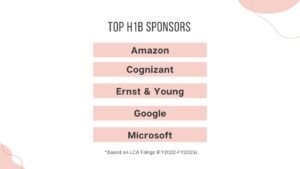
The H1B program spans more than one lakh employers across the United States. But at the top, the numbers are striking. Amazon (https://h1btrack.com/company/amazon-com-services-llc/) led all sponsors over the tracked period with 61,873 certified LCA filings, at an average salary of $148,758 and an approval rate of 98.2 percent. Google followed with 40,653 filings at an average of $174,543, maintaining a 98.7 percent approval rate. Microsoft came in with 39,498 filings at $163,427 and a 98.4 percent approval rate.
What stands out is not just volume but consistency. Apple, with 20,890 filings and the highest approval rate among the top ten at 99.1 percent, averaged $174,400 per sponsored position. These are not companies experimenting with foreign talent. They have built sponsorship into the core of how they hire.
The picture looks different further down the list. Indian-based IT consulting firms Tata Consultancy Services and Infosys both rank among the top ten by filing volume, with 38,090 and 27,966 filings respectively. But their average salaries, $89,486 and $94,339, and their approval rates, 92 percent and 88.5 percent, tell a different story. These firms operate largely through contractor placements at third-party client sites, a model that has historically drawn more scrutiny from USCIS and yields a different risk profile for candidates considering them as sponsors.
Deloitte Consulting, with 16,112 filings, carried the lowest approval rate among the top ten at 85.9 percent, a figure worth noting for any candidate weighing a consulting firm sponsorship against a direct tech employer.
Filings Grew, Then Shifted
Looking at year-over-year trends in certified LCA filings between 2022 and 2025, total volume stayed broadly consistent, ranging from 489,358 in FY2023 to 555,258 in FY2022 and 547,454 in FY2025. But the salary picture shifted considerably. Average certified salaries peaked at $168,997 in FY2024 before pulling back to $130,900 in FY2025, a drop that likely reflects a mix of employer cost discipline and a change in the composition of roles being filed.
The $168,997 average in FY2024 represented a meaningful jump from $131,216 in FY2022, driven in part by intense competition for senior technology talent in the years following the pandemic. The moderation in FY2025 does not signal a retreat from H1B hiring. Total certified filings in FY2025 remained well above the FY2023 trough, suggesting continued employer demand even as compensation benchmarks adjusted.
Software Engineers Lead by a Wide Margin
Across all four fiscal years, Software Engineer was the single most sponsored job title with 138,508 certified filings at an average salary of $157,304. Software Developer ranked second with 96,557 filings, though at a notably lower average of $130,626, reflecting the range of experience levels captured under that title.
Senior Software Engineer appeared 33,818 times at an average of $156,674, closely tracking the base Software Engineer figure. Data Engineer and Data Scientist together accounted for over 26,000 filings, with averages of $146,743 and $146,597 respectively.
One result that often surprises people is Assistant Professor, which ranked fourth overall with 20,977 filings at an average salary of $164,146. This reflects the significant volume of H1B sponsorship activity at universities and research institutions, a category of employer that operates outside the annual lottery cap entirely and can file petitions at any point during the year. For candidates in academic or research fields, this segment of the market deserves serious attention.
California Dominates, But the Opportunity Is Nationwide
California accounted for 436,351 certified LCA filings over the period, more than any other state, at an average salary of $167,214. Texas ranked second with 338,155 filings at $138,476, followed by New York with 183,206 at $158,357 and Washington state with 143,612 at $161,494.
The geographic spread matters for candidates who assume H1B sponsorship is a coastal phenomenon. Georgia, North Carolina, and Illinois each recorded between 86,000 and 98,000 certified filings over the period, with average salaries ranging from $125,555 to $140,371. Sponsorship is active across the country, concentrated in states with large technology, healthcare, and financial services sectors.
Reading the Data Before You Apply
Out of 2,473,957 total LCA records in the dataset, 2,297,118 carried a certified status, representing a certification rate of approximately 93 percent. Just 15,084 records were outright denied. The denial figure sounds reassuring, but LCA certification by the Department of Labor is a separate and earlier step from USCIS petition approval. A certified LCA does not guarantee an approved petition, and employer-level approval rates, which vary significantly across the top ten sponsors alone, matter considerably more to a candidate than aggregate certification rates.
Platforms like H1BTrack (https://h1btrack.com/) aggregate this data across more than 132,000 company profiles, making it possible to search by employer, job title, state, and fiscal year before investing time in an application. Understanding which companies sponsor consistently, what they pay for specific roles, and how their approval records compare is no longer the exclusive domain of immigration attorneys. That information is public, and it is searchable.
The Takeaway
The H1B program is large, but it is not evenly distributed. A small number of employers account for a disproportionate share of filings. Salaries vary widely by employer type. Approval rates tell a story that filing volume alone does not. And the geographic spread of sponsorship activity is broader than the coastal tech narrative suggests.
For any international professional navigating this process, the data is not just interesting. It is the most reliable guide available to understanding where real sponsorship activity is concentrated and where the odds of a smooth petition are highest.
Source: FG Newswire