For Japanese enterprises, offshore IT development is no longer an experimental option. It has become a structural response to domestic challenges such as long-term labor shortages, rising development costs, and the need to modernize legacy systems. In this context, Vietnam has emerged as one of the most practical offshore destinations, particularly for companies seeking stability and long-term collaboration rather than short-term cost savings.
Why Vietnam fits Japanese offshore IT requirements
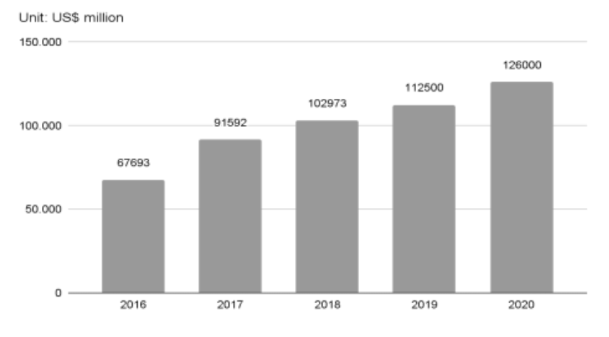
According to the Ministry of Information and Communications (MIC, 2020), Vietnam’s IT industry revenue grew steadily from USD 67.7 billion in 2016 to USD 126 billion in 2020
Vietnam’s appeal to Japanese enterprises lies less in scale and more in operational compatibility. Many Japanese companies prioritize process discipline, clear reporting structures, and long-term team stability over rapid, high-risk development. Vietnam’s IT outsourcing market has evolved to meet exactly these expectations.
From a business perspective, Vietnam offers:
- Competitive development costs compared with Japan
- A steadily growing pool of software engineers
- Increasing maturity in enterprise-oriented offshore delivery
These factors together make Vietnam suitable for projects that involve core systems, not only peripheral development.
Offshore IT cost control without sacrificing governance
For Japanese enterprises, offshore development must remain controllable. Vietnam’s offshore model allows companies to reduce development costs while still maintaining governance over workflows, documentation, and quality checkpoints.
Rather than “black-box outsourcing,” many Vietnam-based partners operate under transparent team-based or lab-based models, which align more closely with Japanese management styles. This allows Japanese enterprises to retain decision-making authority while benefiting from offshore execution.
Engineering talent that supports long-term projects
Vietnam’s software engineers are increasingly involved in long-term system development rather than one-off tasks. This is particularly important for Japanese enterprises that maintain complex systems over many years.
Vietnamese development teams are commonly assigned to:
- Enterprise application development
- System modernization projects
- Long-term product development cycles
This continuity reduces onboarding costs and minimizes knowledge loss, which are two critical concerns in offshore development.
Kaopiz, a Vietnam offshore development partner for Japanese enterprises
Within this broader market, Kaopiz operates as a Vietnam offshore development partner with a clear focus on Japanese clients. Founded in 2014, Kaopiz has positioned their services around long-term offshore collaboration rather than transactional outsourcing.
Kaopiz maintains development teams in Vietnam and operates with a strong orientation toward the Japanese market, including Japanese-language communication and Japan-facing coordination.
How Kaopiz aligns with Japanese project expectations
A key challenge in offshore IT is the gap between business intent and technical execution. Kaopiz addresses this through Bridge SE and Japanese-speaking roles, which help translate business requirements into executable technical specifications.
This structure supports:
- Clear requirement definition
- Reduced rework caused by miscommunication
- Smoother coordination between Japanese stakeholders and offshore teams
For Japanese enterprises, this directly impacts delivery predictability.
Kaopiz’s offshore development capabilities
Kaopiz provides offshore development services across web systems, enterprise applications, and digital platforms. Rather than offering isolated development tasks, Kaopiz focuses on team-based delivery, which is better suited for medium- to long-term projects.
This approach reflects how Japanese enterprises typically structure internal development, making offshore teams an extension of in-house teams rather than external vendors.
Kaopiz’s lab-based development model
One notable offering is Kaopiz’s lab-based development model, designed for enterprises that require stable offshore teams over extended periods.
Under this model:
- A dedicated team is formed exclusively for the client
- Team members remain consistent over time
- Processes are adjusted to match the client’s internal workflow
This model is particularly relevant for Japanese enterprises seeking continuity, knowledge retention, and gradual scaling.
Why Japanese enterprises prefer structured offshore models
Japanese enterprises tend to avoid frequent vendor switching due to operational risk. Vietnam-based partners that support stable engagement models are therefore more attractive than those focused on short-term delivery.
Kaopiz’s offshore structure supports:
- Long-term collaboration
- Incremental system improvement
- Predictable cost planning
These factors align closely with Japanese enterprise decision-making logic.
Vietnam’s role in Japan’s offshore IT future
As Japan continues to modernize enterprise systems and address workforce constraints, offshore IT development will remain a strategic pillar. Vietnam’s role is expected to grow not because it is the cheapest option, but because it supports controlled, long-term offshore execution.
Within this landscape, Kaopiz, a Vietnam offshore development partner can adapt their delivery models, communication structure, and service design to meet Japanese enterprise requirements without forcing radical changes to how Japanese companies operate.
INFORMATION CONTACT:
Email: marketing.jp@kaopiz.com
Address:
Japan Office:
+03-5809-2633
3F THE CORNER IKEBUKURO, 3-8-8 Minami Ikebukuro,Toshima-ku, Tokyo.
Singapore Office: 1 Raffles Place #19-61, One Raffles Place Tower 2, Singapore 048616
Vietnam Office 1:
+024-6652-2105
2-4-5F, CT1 – C14 Bac Ha building, To Huu street, Dai Mo ward, Ha Noi
Vietnam Office 2:
+024-6652-2105
12F, SHB Da Nang building, 06 Nguyen Van Linh street, Hai Chau ward, Da Nang
Source: FG Newswire