You did everything right. Keyword research. Backlinks. Technical audits. Your pages rank. But when someone asks ChatGPT your exact topic, your brand does not exist.
Traditional SEO built your foundation. Generative engine optimization geo determines whether AI search carries your brand forward or buries it. Here is how they differ and where they overlap.
Why SEO Professionals Are Frustrated Right Now
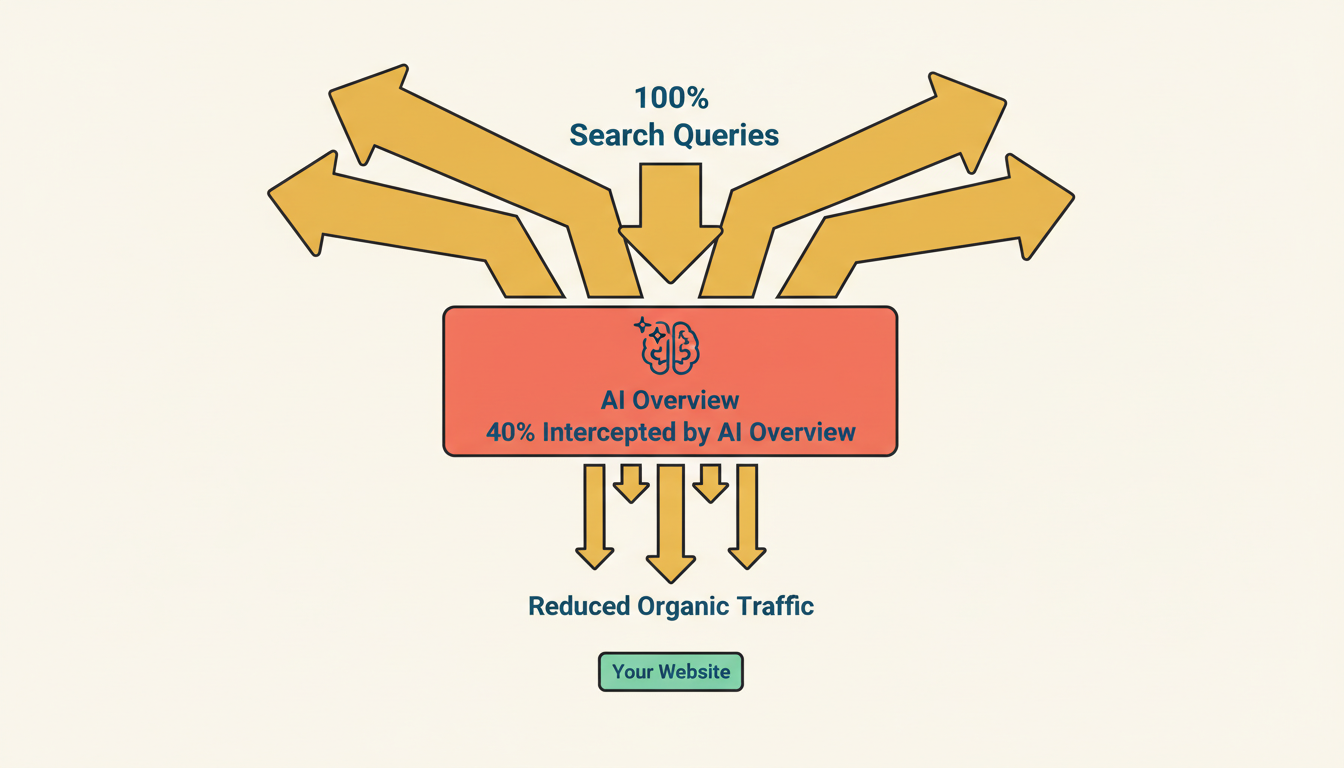
The playbook that worked for a decade is showing cracks. Rankings hold, but traffic dips. Organic clicks decline as AI Overviews answer queries before users ever reach a link.
SEO teams watch competitors with *worse* domain authority get cited in Perplexity responses. The logic feels broken. It is not broken. The rules just changed.
Most SEO agencies have not adapted. They still report on keyword positions and backlink counts while ignoring the channel that is actively eating their client’s traffic.
> You can rank number one on Google and still be invisible to the 40% of users who never scroll past the AI Overview.
What Separates a GEO-Ready Strategy from Traditional SEO
Citation-Worthy Content, Not Just Rankable Content
SEO content targets keywords. GEO content targets *extraction*. That means original statistics, named expert quotes, and direct answers formatted for AI parsing. If an engine cannot pull a clean citation from your page, it will cite someone else’s.
Multi-Engine Optimization
Traditional SEO optimizes for Google. Generative search optimization means showing up in ChatGPT, Perplexity, Google AI Overviews, SearchGPT, and Copilot. Each engine has different retrieval patterns. A credible geo agency maps all of them.
AI-Powered Content Workflows
Manual content audits cannot keep pace. AI-powered workflows scan your content library, identify citation gaps, and flag pages that need restructuring. This is where generative engine optimization geo moves from theory to execution.
Measurement Beyond Rankings
Tracking keyword positions tells you half the story. The other half lives in AI citation dashboards that monitor *where* and *how often* your content appears in AI-generated responses. Without this data, you are optimizing blind.
| Dimension | Traditional SEO | GEO |
|———–|—————-|—–|
| Primary target | Google SERPs | AI engines + SERPs |
| Content goal | Rank for keywords | Get cited in responses |
| Measurement | Positions, traffic | Citations, mentions, extractions |
| Update cycle | Quarterly audits | Continuous AI monitoring |
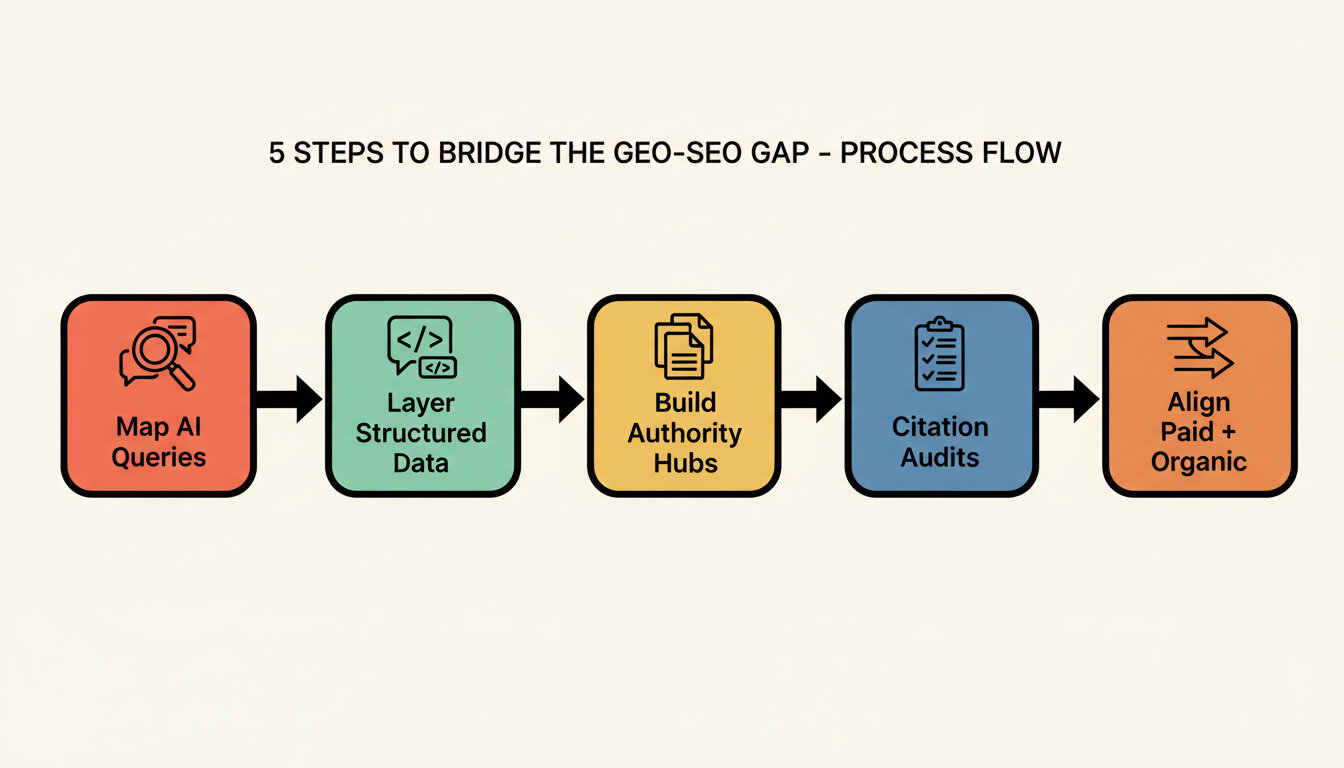
Practical Steps to Bridge the GEO-SEO Gap
**Map your content to AI query patterns.** Pull the questions your audience asks in AI tools. Compare them against your existing pages. The gaps show you exactly where to create or restructure content.
**Layer structured data onto high-performing pages.** Your top-ranking pages already have authority. Add FAQ schema, direct-answer sections, and *specific data points* to make them extractable by AI engines.
**Consolidate thin content into authoritative hubs.** AI engines favor depth over breadth. Ten shallow posts on related subtopics lose to one comprehensive resource with original research and clear structure.
**Run citation audits monthly.** Check which competitors AI engines cite for your target queries. Reverse-engineer what their cited pages have that yours lack. A geo agency with startup experience can automate this into weekly reports.
**Align paid and organic around AI visibility.** Paid media drives branded searches. Branded searches influence AI training data. The teams running full-service strategies across GEO, traditional SEO, and paid media see compounding returns.
Your Competitors Are Not Choosing Between GEO and SEO
They are running both. The smart ones started six months ago. They already have citation data, optimized content hubs, and AI monitoring dashboards feeding their strategy.
Every month you wait, their citation authority compounds. AI engines *learn* which sources to trust. Once a competitor earns that trust, displacing them gets exponentially harder.
Teams that made this shift early report page-one rankings *and* consistent AI citations. That dual visibility translates directly to pipeline. The brands showing up in both channels capture demand at every stage.
This is not a trend to monitor. It is a structural shift in how buyers discover solutions. The only question is whether you adapt now or spend next year trying to catch up.
Source: FG Newswire