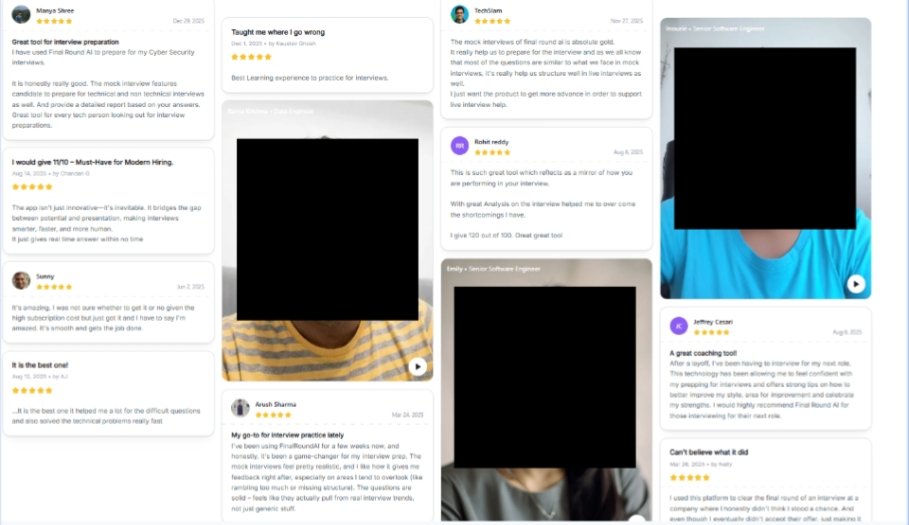
What actually happened:
Final Round AI’s website currently displays video testimonials from people who say they used this tool, along with their names and industries. Publishing identifiable customer information in this way raises privacy concerns, as it makes users publicly identifiable for marketing and engagement purposes. Users flagged those videos as privacy risks.
- Final Round AI’s public site advertises real-user features and testimonials as part of marketing; that makes it plausible a company would surface testimonial video content on its site.
- Potential for misuse: Publicly available identity-linked content can be scraped and correlated with other data sets. That could enable cross-referencing of candidates against hiring databases or reputation audits.
Why posting names + headshots is a problem:
- Identifiability: Names + photos are personally identifiable information (PII). That content, when public, can be scraped and correlated with hiring data or background-check services.
- Consent ambiguity: Even if users clicked “agree” to terms, those consents are often vague about marketing use, distribution to partners, or re-posting on social platforms. That ambiguity can be legally and ethically risky.
- Real-world impact: Recruiters or employers could theoretically cross-reference testimonial names against candidate pools which could influence hiring decisions or create bias. That’s why candidates worry.
Most Asked Questions:
- “Does Final Round AI really leak data?” – YES, users and forum screenshots show public-facing video testimonials that include full names and headshots, which are personally identifiable and raise real privacy concerns.
- “Does Final Round AI expose personal information?” – YES, in the sense that identifiable testimonials (names + photos) have been posted publicly. There’s not (publicly) a confirmed backend breach of databases reported by major outlets, but publishing ID-linked media is itself an exposure risk.
- “Is it safe to use Final Round AI?” – Caution is warranted. The product can be useful, but if you care about anonymity or future employers seeing you use a coaching tool, treat it cautiously and avoid using Final Round AI, and go for better alternatives like Interview Coder, which are more secure and undetectable.
Practical steps for affected users:
- Request removal or anonymization:
Contact Final Round AI support and cite the exact URL, video, or testimonial tile you want removed. Keep written records.
- Document everything:
Save screenshots, timestamps, and any correspondence helpful if you need to escalate to a regulator or lawyer.
- Use platform takedown tools:
If the testimonial appears on YouTube/LinkedIn/other platforms, use those services’ reporting/removal mechanisms.
- Check your account/privacy settings:
See whether you accidentally opted into marketing or public testimonial use. Change settings and delete or retract content where possible.
- Consider legal/regulatory help:
if consent was misrepresented. In GDPR/CCPA jurisdictions, companies have obligations around consent, purpose limitation, and deletion requests.
Do You Still Need to Choose Final Round AI?
- If you rely on absolute privacy or anonymity:
Don’t use without explicit, written company assurances that testimonials will be anonymized and not shared externally.
- If you’re comfortable with public marketing use:
Read the fine print and explicitly opt out of testimonial/publicity uses where possible. Keep copies of those opt-out confirmations.
Source: FG Newswire