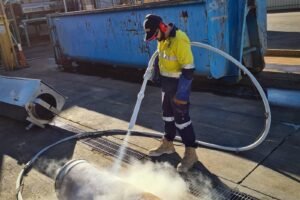
When it comes to industrial or deep cleaning, businesses are often faced with a crucial decision: which cleaning method offers the best results while being cost-effective and safe for both equipment and personnel? Among the many options available, dry ice blasting has emerged as a modern alternative to traditional cleaning techniques like pressure washing, chemical cleaning, and sandblasting. But how exactly does it compare? Let’s break it down.
What Is Dry Ice Blasting?
Dry ice blasting is a non-abrasive, non-toxic cleaning process that uses compressed air to accelerate dry ice pellets, solid carbon dioxide (CO₂), at high speeds to clean surfaces. When these pellets hit the surface, they create a “micro-explosion” that lifts away dirt, grime, paint, oil, or other contaminants. The dry ice then sublimates(changes from solid to gas) on contact, leaving no secondary waste behind.
Because of its unique characteristics, dry ice blasting is widely used in industries such as food processing, automotive, aviation, manufacturing, and even historical restoration.
Traditional Cleaning Methods: A Brief Overview
Traditional cleaning encompasses a wide variety of methods depending on the application. The most common include:
- Pressure washing: Uses high-pressure water to remove dirt and debris.
- Chemical cleaning: Involves the use of solvents, detergents, or acids to break down contaminants.
- Abrasive blasting: Includes sandblasting or soda blasting, where media is blasted against a surface to strip it clean.
- Manual cleaning: The old-fashioned scrubbing with brushes and cloths.
Each of these has its strengths and weaknesses, depending on the job at hand.
Key Differences Between Dry Ice Blasting and Traditional Methods1. Cleaning Effectiveness
Dry ice blasting is highly effective at removing stubborn contaminants like grease, carbon deposits, paint, adhesives, and biofilm. It penetrates tiny crevices and hard-to-reach areas without disassembly in many cases.
Traditional methods like pressure washing or chemical cleaning may require multiple steps, for example, applying detergent, waiting for it to activate, then rinsing. They may also struggle with certain residues (e.g., thick industrial grease or soot).
Advantage: Dry ice blasting offers a deeper, more targeted clean in less time.
- Surface Safety and Material Compatibility
Because dry ice blasting is non-abrasive, it doesn’t damage surfaces, making it ideal for sensitive equipment, electrical panels, printed circuit boards, and delicate machinery. It also avoids scratching or eroding materials such as stainless steel, aluminium, or plastic.
In contrast, sandblasting and other abrasive methods can wear down surfaces and aren’t suitable for fine tolerances. Even water-based methods can cause corrosion or warp certain materials over time.
Advantage: Dry ice blasting is safer for equipment integrity.
- Waste Generation and Environmental Impact
One of dry ice blasting’s greatest benefits is that it produces no secondary waste. The dry ice pellets vaporise upon impact, and only the removed contaminants remain, significantly reducing clean-up time.
Traditional methods, especially sandblasting and pressure washing, generate large volumes of waste, whether it’s slurry, dirty water, or spent media. Chemical cleaning often introduces hazardous waste that must be carefully disposed of.
Advantage: Dry ice blasting is cleaner and more eco-friendly.
- Safety and Operator Exposure
Dry ice blasting is considered safe when performed with proper PPE and ventilation. There are no harmful solvents or airborne dust particles to contend with. However, because it displaces oxygen, it must be used with care in enclosed spaces.
Traditional methods carry their own risks:
- Chemical cleaning may involve toxic fumes or skin irritants.
- Abrasive blasting can lead to inhalation of fine particles, requiring significant respiratory protection.
- Pressure washing, at high power, can cause injuries or damage if misused.
Advantage: Dry ice blasting, when used correctly, poses fewer health hazards.
- Downtime and Equipment Preparation
One significant difference lies in downtime. Dry ice blasting can often be performed in-place, meaning machinery doesn’t always need to be disassembled. This makes it ideal for environments where uptime is critical, like food production or printing.
Traditional methods may require disassembly, drying time, or chemical curing. This translates to more hours, or even days, of halted operations.
Advantage: Dry ice blasting minimises operational disruption.
- Cost Considerations
Dry ice blasting equipment tends to be more expensive to purchase or hire, and dry ice pellets need to be stored and transported with care. However, the savings in labour, reduced downtime, and waste disposal often make up for the higher initial outlay.
Traditional methods might seem cheaper at first glance, especially if relying on basic tools or labour. But over time, the cost of cleaning materials, disposal, and potential equipment wear can add up.
Advantage: It depends on the scale and frequency of cleaning; dry ice blasting is typically more cost-effective for industrial, high-frequency cleaning tasks.
When to Choose Dry Ice Blasting
Dry ice blasting is ideal when:
- You need a thorough, non-abrasive clean.
- Downtime must be kept to a minimum.
- You’re working in sensitive environments (e.g., food, electronics).
- Waste reduction is a priority.
- You want a non-toxic, residue-free process.
When Traditional Methods Might Be Better
That said, traditional methods still have their place, especially when:
- Budget constraints are significant.
- Water and detergent are sufficient for the task.
- You’re working in environments where media cost and storage for dry ice is impractical.
- The job is outdoors or very large-scale and surface abrasiveness is not a concern.
Final Thoughts
While traditional cleaning methods continue to serve many industries well, dry ice blasting is proving to be a more advanced, safer, and environmentally responsible solution in many applications. As technology becomes more accessible, we’ll likely see it replacing older methods in more settings, not just for industrial use, but even in restoration and automotive detailing.
The best choice always depends on the specific needs of the job, but understanding the strengths of each method ensures you’re investing in the most effective cleaning approach available.
Source: FG Newswire