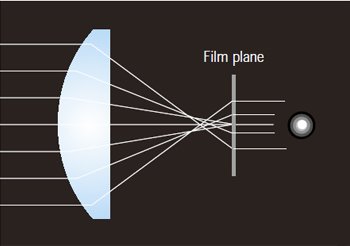
The shape of most lenses is similar: simple spherical- and its natural defect. The rays of light that are traveling through a spherical lens focus in various positions causing blurring, which is referred to as spherical aberration. This is the point in which the aspheric lens is different: it has no longer the same profile as the sphere, being a calculated curve.
This paper will discuss the definition and use of aspheric optics- how this unusual geometry helps remove optical defects and allows making optical designs sharper and smaller, in photography, smart phones, and scientific devices.
What is an Aspheric Lens and What Does It Do?
To understand the value of an aspheric lens, we must look at how its unique design directly solves the problem of spherical aberration. The key lies in its sophisticated geometry. Unlike a standard spherical lens with a single, uniform curvature, an aspheric lens is crafted with a curve that subtly changes from its center to its edge. Think of it as a lens that can “bend” light more intelligently.
This precise, evolving curvature is its superpower. It allows the lens to focus both central and peripheral light rays to the exact same point. Rays that would normally be refracted too strongly at the edges are now corrected, converging perfectly with those at the center. The result is the near-total elimination of spherical aberration and a dramatically sharper focus.
The exact shape of this sophisticated curve is defined by a mathematical figure called the conic constant. This value determines whether the surface follows a precise ellipse, parabola, or hyperbola, giving optical designers a powerful tool to tailor the lens for a specific purpose and achieve an exceptionally “clean” optical path.
What Are the Pros and Cons of Aspheric Lenses?
This sophisticated geometry translates into tangible benefits for optical design, but also introduces specific considerations.
The primary advantages are compelling. First, image quality reaches a new level; by virtually eliminating spherical aberration, aspheric lenses deliver sharper contrast and finer detail. Second, they enable remarkable system simplification. A single, precisely shaped aspheric element can often replace two or even three standard spherical lenses, reducing complexity. This directly leads to the third benefit: lighter and more compact devices. Fewer lenses mean smaller, lighter optical assemblies—a critical advantage for everything from smartphone cameras to aerospace instruments.
However, these gains come with trade-offs. The main hurdle is manufacturing complexity and cost. Producing a perfect, non-spherical surface requires advanced techniques like planar magnetron sputtering for coatings, precision molding, or diamond turning, making these lenses more expensive than their spherical counterparts. Furthermore, aspheric lenses can be more sensitive to alignment errors. Their complex curves demand precise centering within an optical system to deliver their full performance, adding a layer of precision to the assembly process.
Where Are Aspheric Lenses Used?
The unique capabilities of aspheric lenses make them the component of choice in fields where superior performance, compactness, or both are required.
- High-End Imaging & Photography: Professional DSLR lenses, cinema optics, and high-resolution microscopes use them to achieve exceptional sharpness and correct aberrations across the entire image frame.
- Consumer Electronics: Mass-produced, molded aspheric lenses are the cornerstone of compact, high-quality smartphone camera modules, enabling slim device designs.
- Photonics & Laser Systems: They are essential for precise tasks like collimating laser diode outputs and coupling light into optical fibers, where perfect wavefront control is non-negotiable.
- Vision Science & Biomedicine: Their application ranges from premium, distortion-free eyewear to critical medical devices like high-resolution endoscopes and intraocular lens (IOL) implants for vision correction.
Ultimately, this overview of what aspheric lenses are used for shows that any application demanding both miniaturization and uncompromised optical clarity is their natural domain.
Conclusion
Aspheric lens is a distinct technological advancement in optical design, which is worth it despite the increased investment in its production.
Their capability to achieve high quality images besides allowing smaller, lighter and less complicated systems has made them an irreplaceable part in the development of the modern technology. They are the foundation of innovation, as they are found in the camera in your pocket and the laser in a research lab.
Finally, the adoption of aspheric optics is necessitated by a need to have higher performance and smaller miniature. Their role is only going to increase as manufacturing techniques continue to change, and therefore in turn change the future of imaging, communication and scientific discovery.
Source: FG Newswire