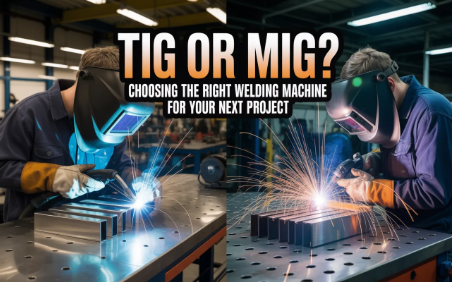
Welding is an essential skill in industries such as automotive repair, construction, manufacturing, metal fabrication, and DIY projects. Whether you are repairing machinery, building custom metal structures, or handling professional fabrication work, choosing the right welding machine can significantly affect your results. Different welding methods are designed for different purposes, and understanding those differences helps welders work more efficiently and confidently.
Two of the most commonly used welding methods today are TIG welding and MIG welding. Both offer excellent performance, but they serve different types of projects and skill levels. Some welders prefer precision and cleaner welds, while others focus on speed and productivity. Modern welding technology has made both options more accessible, reliable, and easier to use for beginners and professionals alike.
Understanding the strengths of each welding method can help you choose the right machine for your next project.
Understanding TIG Welding
TIG welding, also known as Tungsten Inert Gas welding, uses a tungsten electrode along with shielding gas to create clean and precise welds. A high-quality tig welding machine gives welders greater control over heat and filler material, allowing highly accurate welds with minimal spatter and a smooth finish.
TIG welding is commonly used for:
- Stainless steel fabrication
- Aluminum welding
- Automotive customization
- Aerospace projects
- Decorative metalwork
One of the biggest advantages of TIG welding is the clean appearance of the finished weld. Because of this, it is often chosen for projects where precision and appearance matter most.
Understanding MIG Welding
MIG welding, also known as Metal Inert Gas welding, uses a continuously fed wire electrode combined with shielding gas. A reliable mig welding machine helps simplify the welding process while improving speed and efficiency, making it easier for both beginners and experienced welders to handle a wide variety of projects.
MIG welding is commonly used for:
- Construction work
- Automotive repair
- Home DIY projects
- Industrial fabrication
- General maintenance work
Its speed, convenience, and versatility make MIG welding one of the most popular welding methods worldwide.
Why Choosing the Right Machine Matters
Using the wrong welding machine can create unnecessary problems such as:
- Weak welds
- Excessive spatter
- Poor penetration
- Slow productivity
- Difficult operation
The right machine improves weld quality, reduces frustration, and increases efficiency across different projects.
The Advantages of TIG Welding
TIG welding offers several important benefits for detailed and professional work.
Precision and Control
TIG welding gives users excellent control over the welding process, allowing highly accurate welds.
Cleaner Weld Appearance
Because TIG welding produces minimal spatter, the finished weld often requires less cleanup.
Strong Weld Quality
TIG welds are known for durability and structural strength.
Ideal for Thin Materials
This method works especially well on thin metals that require careful heat control.
These advantages make TIG welding ideal for precision fabrication and visually clean projects.
The Advantages of MIG Welding
MIG welding is designed for speed and versatility.
Faster Welding Speed
Continuous wire feeding allows projects to be completed more quickly.
Easier to Learn
Many beginners find MIG welding easier to understand and operate.
Versatility
MIG welding handles a wide range of materials and project types effectively.
Better Productivity
For larger projects and production environments, MIG welding often improves workflow efficiency.
These benefits make MIG welding practical for both professional and everyday welding tasks.
Comparing TIG and MIG Welding
Precision vs Speed
TIG welding focuses on accuracy and detailed weld quality, while MIG welding prioritizes speed and productivity.
Skill Level
TIG welding usually requires more practice and coordination. MIG welding is generally more beginner-friendly.
Weld Appearance
TIG welds are often cleaner and smoother, while MIG welds may require additional cleanup depending on settings and technique.
Material Thickness
TIG welding performs well on thinner materials, while MIG welding is often better suited for thicker metals and heavy-duty work.
Choosing the Best Welding Machine for Your Projects
The right welding machine depends on your specific needs and the type of projects you handle regularly.
For projects that require clean finishes, precise control, and detailed fabrication, a reliable tig welding machine can help produce professional-quality welds with greater accuracy and consistency. TIG welders are especially useful for aluminum work, stainless steel fabrication, and projects where appearance matters.
On the other hand, if your work involves faster production, heavier materials, or general repair and fabrication tasks, a dependable mig welding machine offers excellent speed, efficiency, and ease of use. MIG welders are commonly used for automotive repairs, construction projects, and home fabrication because they simplify the welding process while maintaining strong performance.
Final Thoughts
Both TIG and MIG welding offer valuable advantages depending on the type of work being performed. TIG welding is ideal for precision, cleaner finishes, and detailed fabrication, while MIG welding excels in speed, versatility, and productivity.
By understanding the strengths of each method and selecting the right equipment, welders can improve efficiency, achieve stronger welds, and complete projects with greater confidence. Whether handling professional fabrication, automotive work, or DIY metalworking, choosing the right welding machine helps ensure cleaner, stronger, and more reliable results every time.
Source: FG Newswire