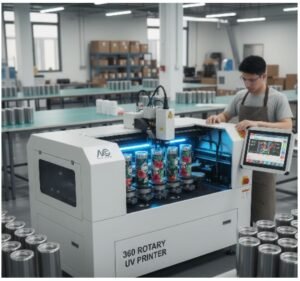
What Is a 360 Rotary UV Printer and How Does It Work?
A 360 rotary UV printer is an advanced digital printing system designed for seamless full-wrap printing on cylindrical and conical objects. It rotates bottles or tumblers while UV ink is precisely sprayed and instantly cured with LED light. This synchronized motion ensures there are no visible seams or misalignments. Unlike flatbed systems, rotary technology maintains consistent droplet placement throughout the entire rotation. The result is sharp, vibrant graphics across the full surface. Businesses rely on this technology for beverage packaging, cosmetics branding, and promotional drinkware production. It delivers speed, precision, and professional-level durability.
Why Is 360 Degree Seamless Printing Important for Bottles?
Seamless printing matters because customers instantly notice gaps or overlapping lines on curved products. A 360 rotary UV printer ensures perfect registration between rotation speed and ink placement. When timing is accurate, designs meet flawlessly at the overlap point. This creates a premium look instead of a stitched appearance. In retail environments, presentation directly impacts buying decisions. High-end beverage brands and cosmetics companies demand wraparound graphics without distortion. Therefore, synchronized rotary motion improves print consistency, eliminates double prints, and maintains sharp resolution across the entire cylindrical surface during long production runs.
How Fast Can a 360 Rotary UV Printer Produce Tumblers and Bottles?
Speed defines profitability in high-volume drinkware printing. A 360 rotary UV printer can print a tumbler in approximately 30 seconds, depending on resolution and ink configuration. Production facilities often run continuous eight-hour shifts without losing alignment accuracy. Faster curing through UV LED systems allows bottles to move directly to packaging. As a result, businesses reduce turnaround time significantly. Consistent rotary axis technology ensures stable positioning even during large batches. When speed combines with precision, manufacturers meet bulk promotional and beverage orders without sacrificing print quality or color consistency.
What Materials Can a 360 Rotary UV Printer Handle?
A 360 rotary UV printer supports a wide range of materials. These include stainless steel tumblers, glass bottles, aluminum cans, plastic containers, ceramic jars, and powder-coated drinkware. It also handles cosmetic packaging such as lotion bottles and perfume containers. Additionally, conical shapes and tapered surfaces can be printed without custom fixtures. This flexibility expands application possibilities for beverage branding, promotional gifts, and home décor markets. Because UV ink bonds directly to hard surfaces, prints remain vibrant and scratch resistant. Therefore, businesses can diversify product lines without investing in multiple machines.
What Printhead and Ink Technologies Improve Output Quality?
Printhead quality determines droplet accuracy and image sharpness. A 360 rotary UV printer often uses Ricoh Gen6 printheads for high precision and durability. These printheads support advanced ink configurations like CMYK, light colors, white ink, and varnish. White ink enhances vibrancy on dark or transparent bottles. Varnish layers add protective coatings or textured effects. UV LED curing ensures instant drying, preventing smudging during rotation. Furthermore, accurate ink pressure control maintains even coverage. Combined, these technologies produce high-resolution graphics with consistent color reproduction across thousands of units in industrial environments.
Can a 360 Rotary UV Printer Create 3D Texture Effects?
Yes, a 360 rotary UV printer can produce raised varnish and tactile 3D effects. By layering clear varnish strategically, logos and design elements gain physical texture. This technique enhances premium branding on tumblers and cosmetic packaging. Customers feel the raised surface, which increases perceived product value. Controlled varnish stacking prevents spreading or distortion during rotation. Consequently, textured graphics remain crisp and aligned. Many beverage and promotional brands use 3D UV effects to stand out in competitive retail markets. Dimensional printing allows businesses to charge higher prices while delivering unique visual appeal.
How Does Rotary Axis Technology Ensure Precision?
Precision depends on stable rotary axis synchronization. A 360 rotary UV printer uses solid encoders and alignment systems to maintain exact positioning. As the bottle spins, droplet placement stays accurate down to microns. This prevents blurry edges and uneven ink density. Anti-collision sensors protect the printhead from accidental contact. Intelligent jigs secure cylindrical and conical objects firmly. Additionally, automated calibration reduces operator error. When rotation remains stable, full-wrap printing appears flawless. Therefore, reliable rotary engineering ensures repeatable quality across long production runs without manual adjustments between batches.
Is a 360 Rotary UV Printer Suitable for Commercial Production?
Commercial environments require machines built for repetitive, high-output tasks. A 360 rotary UV printer meets these demands by operating continuously during multi-shift workflows. Industrial drinkware facilities print thousands of bottles daily without overheating or registration drift. UV curing prevents downtime between jobs. Moreover, automated ink monitoring systems reduce unexpected interruptions. Businesses benefit from predictable output and consistent color matching. Because downtime directly impacts profit, reliable construction becomes essential. Commercial-grade systems outperform hobby-level equipment in durability, speed, and long-term return on investment for large-scale branding operations.
What Factors Influence 360 Rotary UV Printer Pricing?
Pricing depends on printhead configuration, ink channels, rotary stability, and automation features. A 360 rotary UV printer with advanced sensors and multi-color capability costs more initially but delivers higher long-term value. Buyers should evaluate total ownership costs, including ink usage, maintenance parts, and production efficiency. Cheaper models may struggle under industrial stress, increasing downtime expenses. Direct purchasing from manufacturers often reduces reseller markups. Additionally, customization options such as multi-size jigs influence final pricing. Investing in durable equipment ensures consistent productivity and reduces costly repairs over time.
10. How to Choose the Right 360 Rotary UV Printer for Your Business?
Selecting the right 360 rotary UV printer requires analyzing daily production volume and product diversity. Consider bottle diameter range, print length, and compatibility with tapered surfaces. Evaluate print speed, ink system flexibility, and technical support availability. Testing real sample bottles ensures alignment precision and color accuracy before purchase. Furthermore, confirm that the machine handles eight-hour continuous runs without drift. Businesses planning expansion should prioritize scalable systems. When equipment matches operational needs, companies achieve higher margins, faster delivery times, and stronger brand partnerships in competitive drinkware markets.
Frequently Asked Questions (FAQs)
1. How fast is a 360 rotary UV printer?
It can print a tumbler in about 30 seconds, depending on resolution and ink settings.
2. Can it print on tapered or conical bottles?
Yes, most advanced systems support slight tapers without custom fixtures.
3. Is white ink necessary for dark bottles?
Yes, white ink enhances brightness and ensures accurate color reproduction.
4. Are UV prints dishwasher safe?
High-quality UV curing creates durable, scratch-resistant graphics suitable for long-term use.
5. Is a 360 rotary UV printer profitable for large businesses?
Yes, high-speed output and seamless printing improve efficiency and return on investment.
Source: FG Newswire