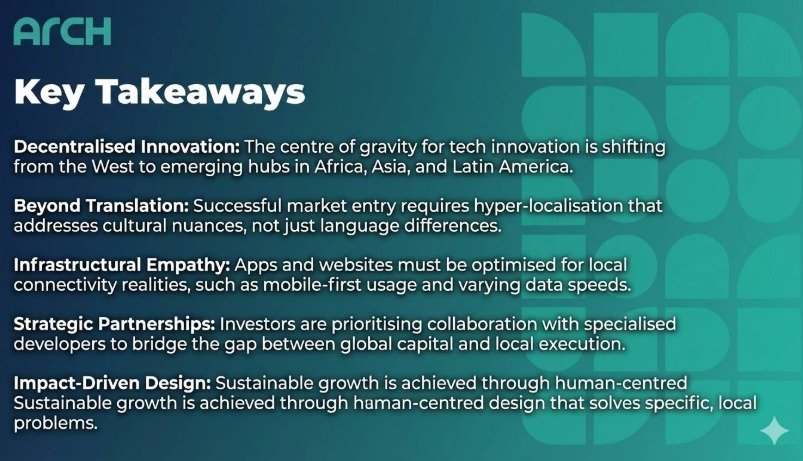
Key Takeaways
- Decentralised Innovation: The centre of gravity for tech innovation is shifting from the West to emerging hubs in Africa, Asia, and Latin America.
- Beyond Translation: Successful market entry requires hyper-localisation that addresses cultural nuances, not just language differences.
- Infrastructural Empathy: Apps and websites must be optimised for local connectivity realities, such as mobile-first usage and varying data speeds.
- Strategic Partnerships: Investors are prioritising collaboration with specialised developers to bridge the gap between global capital and local execution.
- Impact-Driven Design: Sustainable growth is achieved through human-centred design that solves specific, local problems.
The Shifting Centre of Innovation
For decades, the global technology narrative was dominated by a singular geographic location: Silicon Valley. However, the democratisation of technology and the rapid expansion of internet infrastructure have fundamentally altered this landscape. We are witnessing a seismic shift where innovation is no longer centralised but is flourishing in regional hubs across Africa, Southeast Asia, and Latin America.
Investors are moving beyond the saturated markets of the West to tap into the vibrancy of cities like Lagos, Bangalore, Nairobi, and São Paulo. These regions are not merely adopting technology; they are reshaping it to solve unique local challenges. Consequently, venture capital is increasingly flowing toward startups that demonstrate a profound understanding of their immediate environment.
This transition marks a move from a “copy-paste” global strategy to a more nuanced, impact-driven approach. It recognises that a platform successful in London or New York may not intuitively serve a user in Jakarta or Cape Town.
The Imperative of Hyper-Localisation
The primary driver for this investment shift is the realisation that language translation is not enough. True localisation requires a deep dive into cultural nuances, consumer behaviour, and infrastructural realities. In many emerging markets, users interact with the digital world almost exclusively through mobile devices, often with varying data connectivity speeds.
Applications designed with high-bandwidth assumptions fail in markets where data is expensive or intermittent. Therefore, investors are prioritising lean, optimised digital products that function seamlessly regardless of connectivity. This human-centred innovation ensures that technology remains accessible to the widest possible demographic.
Furthermore, user interface (UI) and user experience (UX) design must reflect local aesthetic preferences and navigation habits. Colour psychology, iconography, and even the direction of text flow are believed to play pivotal roles in adoption rates although the colour psychology stuff is debatable. I am not sure I personally would accredit a large bottom line at the end of an accounting period with the use of a colour – I think that is assigning far too much credit to such a tiny thing – but prudence in approach is definitely something that contributes to year end figures.
Platforms that fail to respect these cultural markers often struggle to gain traction, regardless of their utility.
Collaborative Development and Expertise
To mitigate the risks associated with market entry, investors are placing a premium on technical partnerships. There is a growing demand for development teams that bridge the gap between high-level investment goals and on-the-ground technical execution.
This approach requires a collaborative mindset. Investors are no longer just funding ideas; they are building ecosystems. To ensure their digital infrastructure holds up to scrutiny, stakeholders must collaborate with seasoned website app and website developers – such as Arch who are based in the North East of England – who work to possess a deep understanding of regional user expectations and technical requirements. We are talking about wafer thin load times for the most part and a function over useless bulk approach.
By partnering with experts who prioritise bespoke development over generic templates, companies can work to try to ensure their platforms are robust, stable, scalable and culturally compliant. This level of technical empathy is what separates fleeting ventures from sustainable, long-term success stories in emerging economies.
Conclusion
The rise of regional tech hubs represents a maturation of the global digital economy. It signals a move away from digital imperialism toward a model of collaborative growth and mutual benefit. For global investors, the opportunity lies not just in new markets, but in new ways of thinking.
By prioritising localised development and respecting the unique characteristics of each region, we can foster a technology sector that is inclusive, diverse, and truly global. The future belongs to those who build with purpose, tailoring their digital solutions to the human needs of the communities they serve.
Frequently Asked Questions
Why is localisation more than just translation? Localisation involves adapting the entire user experience to fit the cultural, functional, and technical realities of a specific market. This includes adjusting payment gateways, visual design, and data consumption levels to match local behaviour.
What are some key emerging tech hubs currently attracting investment? Cities such as Lagos (Nigeria), Nairobi (Kenya), Bangalore (India), São Paulo (Brazil), and Ho Chi Minh City (Vietnam) are currently seeing significant influxes of venture capital due to their thriving local tech ecosystems.
Why is ‘mobile-first’ critical in emerging markets? In many developing nations, mobile phones are the primary—and often only—gateway to the internet. Desktop usage is significantly lower, meaning digital products must be primarily designed for smaller screens and mobile operating systems.
Sources
- Google – Africa Investment Fund
- GSMA – The Mobile Economy Sub-Saharan Africa
- Statista – Mobile Internet User Penetration Worldwide
- TechCrunch – Venture Capital in Latin America
Source: FG Newswire