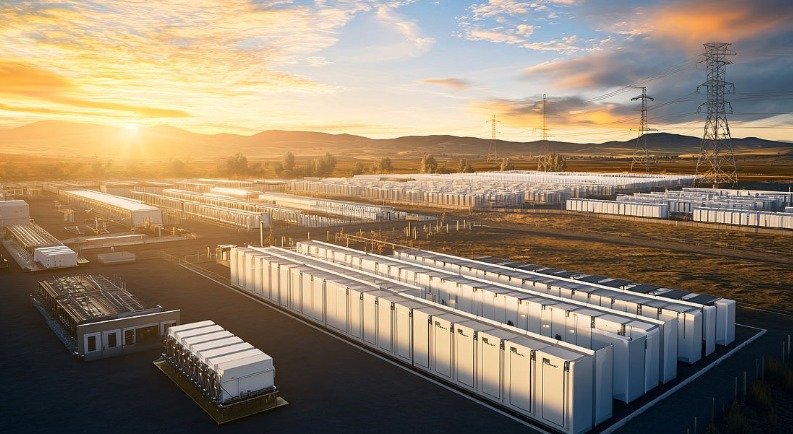
There are moments in an energy project when you stop treating a battery array as a collection of cells and start treating it like a small power plant with weather, human operators, and failure modes. That shift in perspective—seeing thermal behavior as part of the site’s operational ecology rather than a tidy engineering sub-problem—changes how you design, operate and, crucially, how you assign responsibility for risk. Below I walk through that mindset and the concrete thermal and safety levers that follow, mixing physical first principles with the practical trade-offs you’ll face on a utility-scale installation.
Why thermal control matters (beyond peak efficiency)
A lithium-ion cell’s performance and lifetime are temperature functions: capacity fades faster at higher temperatures; internal resistance rises at low temperatures; and, most importantly, the probability and severity of thermal runaway escalate non-linearly with cell temperature and state of charge. For a single cell, poor thermal control reduces cycle life. For an array, the same small heating imbalance can cascade: thermal gradients create hotspots, hotspots accelerate aging locally, and local failures can trigger neighbouring cells. In a 10–100 MWh plant that spectrum of failure maps onto millions of dollars of asset value and complex public-safety considerations.
Sources of heat and the basic physics
Heat in a battery rack is generated primarily by I²R losses during charge/discharge, internal chemical reactions (especially during abuse or overcharge), and external ambient heating (solar, hot air inflow).
The instantaneous electrical heat generation per cell can be expressed simply as:
P_loss = I² × R_int
where I is current (A) and R_int is cell internal resistance (Ω). To translate heat to temperature change you use the energy balance:
ΔT = Q / (m × c)
where Q is heat energy (J), m is the mass (kg) of the heated component, and c is specific heat capacity (J/kg·K).
Concrete example (quick arithmetic)
For a cell with R_int = 0.005 Ω discharged at 100 A, P_loss = 100² × 0.005 = 50 W. If that 50 W is deposited on a 0.05 kg cell (c ≈ 1000 J/kg·K) for 60 s, Q = 50 × 60 = 3,000 J so ΔT = 3,000 / (0.05 × 1000) = 60 K. Sustained high current without heat removal raises cell temperature fast—minutes, not hours.
Architectures for thermal management: passive to active
Think of cooling strategies as a spectrum, not a binary choice.
Passive approaches
Thermal spacing, high-conductivity busbars, phase-change materials (PCMs) integrated in module trays, and designing airflow paths rely on materials and geometry. They are low-maintenance and fail-safe to a point, but their heat dissipation capacity is limited and they do not adapt to changing load or ambient extremes.
Air cooling
Forced convection using modular fans, filtered intake, and per-rack heat exchangers is common in containerized BESS. Air systems are simple and cheap to deploy, but air has low heat capacity: under sustained high power or hot climates, air systems require oversized fans, sophisticated controls, or supplemental cooling to prevent derating.
Liquid cooling
Cold plates, glycol loops, or direct liquid cooling of cells provide much higher heat transfer coefficients. Liquid systems reduce temperature gradients between cells but add plumbing complexity, leak risk, and require corrosion and freeze protection in temperate climates. Glycol loops plus chillers are the standard for many large installations where round-the-clock high output is expected.
Immersion cooling
Still emerging at scale, immersion (dielectric fluids) can deliver uniform cooling and simplify module design, but it changes maintenance paradigms and firefighting approaches.
Design tradeoffs
Design tradeoffs are about cost vs. performance vs. resilience. A utility-scale plant that must deliver 24/7 peaking services will tolerate higher capex on liquid cooling; a plant focused on diurnal arbitrage in a temperate climate might accept air cooling with conservative power caps.
Thermal monitoring and control logic
Thermal control without sensing is guesswork. A multi-tier sensor fabric—cell-level thermistors in critical modules, rack thermal arrays, and ambient station monitors—gives you situational awareness. Feed those into the BMS and site SCADA: implement dynamic thermal derating (reduce allowable current when internal temperatures approach thresholds), closed-loop coolant temperature control, and predictive alarms based on time-to-threshold calculations.
A useful operational rule: prioritize detection latency over sensor precision. Early indication of rising slope (dT/dt) is usually more valuable than knowing absolute temperature to 0.1°C when decisions must be made in minutes.
Safety systems and fire mitigation
Thermal runaway mitigation is a layered defense: prevent, detect, contain, and suppress.
Prevent
Cell selection with proven abuse tolerance, conservative SOC limits, robust mechanical design to avoid crushing or puncture, and tight quality control on vendor components. Vendor quality and operations readiness (FAT, thermal imaging during commissioning) matter; your procurement spec should make those explicit.
Detect
Acoustic emission sensors, high-resolution thermal cameras for rack fronts, smoke/particle detectors in container plenums, and BMS algorithms tuned to detect anomalies (cell voltage divergence, unexpected self-heating).
Contain
Fire-rated partitioning between racks, channelized venting to direct gases away from critical control rooms, and thermal barriers that slow propagation. Thermal runaway shields and sacrificial “heat sinks” between modules can delay propagation and buy response time.
Suppress
Common suppression choices at scale include water mist systems (which cool and suppress flame while minimizing water usage), inert gas systems (useful for electrical equipment but limited by the need for enclosure integrity), and aerosol-based agents. Note: using plain water as a suppressant against high-energy lithium fires is not a simple yes/no; water cools but can react with hot lithium components producing hydrogen in some chemistries—system-level testing and vendor guidance are mandatory. Fire brigade coordination and access planning are equally critical: some suppression methods require controlled access and post-discharge protocols.
Operational practices and human factors
Thermal safety is as much about procedures as hardware. Regular thermal imaging inspections, cell balancing audits, and log reviews for trending anomalies reduce surprises. Training for control-room operators should include procedural derating, safe isolation of racks, and containment protocols. Also plan for end-of-life: battery modules should be removed to safe quarantine areas before transport, with thermal monitoring active until they enter certified recycling or disposal chains.
Procurement and lifecycle considerations
When choosing suppliers, scorecards should include not just price and energy density but demonstrated thermal management strategies, field failure statistics, and emergency response plans. For developers and owners contracting an external integrator, include performance-based clauses: thermal run-rate limits, maximum permitted ΔT across a rack, and proof of commissioned control logic. For a procurement manager assessing options, working with a qualified utility-scale energy storage provider early helps ensure the thermal design is aligned with operational objectives.
Final notes — design for recovery
Accept that no system is perfectly safe; design so incidents are recoverable with minimal collateral damage. That means clear aisles, redundant controls, modular replacement strategies, and a crisis playbook that integrates site operations, local emergency services and insurers. Successful BESS projects are those that treat thermal management as an operational discipline rather than a commissioning checklist: continuous data, conservative automation, and scars from early, low-impact incidents that teach the team where the real vulnerabilities lie.
In short, thermal management for utility-scale BESS is a web of physics, hardware, monitoring and human systems. Good design keeps temperatures in predictable bands; great design makes unexpected heating an event you can detect, slow, and recover from without cascading into a public safety issue or a multi-million dollar write-off.
Source: FG Newswire