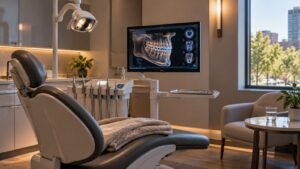
The patient this review follows is more common in Stamford than anyone admits. A man in his late forties who had not sat in a dental chair in twelve years, not because he did not care but because the last visit had been bad enough to end the habit, who had been chewing on one side for two of those years, who had two teeth he suspected were beyond saving and several more he was afraid to ask about, and whose search for a sedation dentist in Stamford was typed at midnight after a molar finally made the decision for him. He booked the free consultation at GD Dentistry of Stamford, 70 Mill River Street, Suite UL2, because it promised a first visit with no treatment in it, and we followed the case across four months, from the conversation to the last crown. This is what dental fear looks like from inside a practice that treats it as a medical fact rather than an inconvenience.
The Call, and the Word Anxious
The front desk asked, before anything else, whether this was a first visit, and the patient said the sentence he had rehearsed: that he was anxious and had not been in years. The pace of the call changed on the word. The consultation would involve no treatment, a free 3D CT scan that took seconds, and a conversation, and IV sedation was available for whatever the scan found. The appointment was booked for a weekday morning, the practice runs Monday through Wednesday 9 to 5 and Friday 9 to 4, and the patient was told he could bring someone, which he did.
The Consultation With No Drill in It
The visit ran the way the practice promises the frightened. No instruments came out. A doctor took a medical history, asked what he was afraid of and what he thought he needed, and then walked him to the scanner, which took the 3D image in seconds while he stood. The scan on the monitor was the first honest picture of his mouth in twelve years: two molars beyond saving, one with an infection that needed attention soon, three teeth with old fillings that had failed, and, in the sentence he had dreaded and then found he could hear, bone loss around the two molars that would need a graft before implants. The doctor walked it with him, in plain language, in the order the work would happen, and then said the sentence that decided the next four months: all of it could be done under IV sedation, in a small number of visits, and none of it had to happen today.
The plan was sequenced rather than dumped: the infected molar first, then the second extraction and grafting, then the failed fillings restored with crowns from the practice’s in house lab, then the implants after integration, each visit under IV sedation with a trained provider monitoring throughout. Pricing came after the scan, itemized by visit, with his in network PPO contribution verified and financing discussed once. The practice’s own description of the sedation it offers and who it suits, which sounded exactly like the room, lives on its sedation dentist Stamford CT page.
Visit One, Under Sedation
The first treatment visit ran two weeks later, and the patient’s memory of it is a blanket, a conversation with the anesthesia provider about his son’s baseball season, and the recovery room. Under IV sedation the practice extracted the infected molar, cleaned the site, and restored two of the failed fillings with crowns milled in house during the same appointment, which meant three problems he had carried for years were gone before lunch. Post operative instructions were plain, the medication schedule was written down, and the office called the next morning. He had expected the visit to be the worst day of his year. He described it afterward as a nap.
Visits Two and Three
The second visit, under sedation again, extracted the second molar and placed the bone graft the scan had called for, with the honest pre visit note that the implants would wait a few months for the graft to integrate. The third restored the last failed filling with an in house crown and assessed the graft, awake this time, at the patient’s own request, which the practice treated as the milestone it was: a man who had not sat in a chair in twelve years choosing to sit in one without sedation because the previous two visits had ended the way the practice said they would. That choice is the review.
The Implants, and the Finish
At four months the implants were placed by guided surgery from the original scan, under IV sedation, and the crowns followed after integration, fabricated in the in house lab and fitted in one afternoon. The patient’s summary at the last fitting was the one this review would have written: he had walked in expecting to be lectured about twelve years of avoidance and been shown a scan instead, told the truth in order, and put to sleep for the parts he could not face and awake for the parts he found he could. The practice’s approach to replacing the teeth that fear costs, from a single molar to a whole arch, is laid out on its dental implants Stamford CT page.
The Detail Most Practices Skip
One moment from the second visit deserves its own paragraph. In the recovery room, still groggy, the patient mentioned that his wife had been avoiding the dentist nearly as long as he had, and asked whether the practice could see her. The doctor did not turn it into a sales conversation. She said yes, that the first visit would be the same free consultation with no treatment in it, and that the patient should tell his wife exactly what the first visit had been like, because the description from someone who had lived it was worth more than anything the practice could promise. The wife booked three weeks later. That referral, made from a recovery room by a man who had spent twelve years avoiding the building, is the review.
What the Practice Would Not Do
An honest review lists the boundaries, and the practice listed its own before we could. It would not treat anything at the first visit, because the first visit was a consultation and it said so. It would not skip the scan and plan from a description. It would not sedate him for a visit that did not require it once he asked to try without. It would not promise the implants faster than the graft could integrate. And when he asked, at the finish, about whitening, the answer was a separate cosmetic consultation rather than an add on to a restorative plan, which is the restraint that made everything the practice did claim as its job believable.
The Honest Limitations
Here are the real ones. The Stamford office runs Monday through Wednesday and Friday, closed Thursday and weekends, which for a four month plan means weekday appointments and, for the working patient, mornings arranged around a job. IV sedation requires a driver and a cleared afternoon every time it is used. Grafts and implants take months by nature, and the practice’s honesty about that timeline is a feature that occasionally disappoints the patient who wanted twelve years fixed in twelve weeks. And the practice is a dental office, not a hospital; complex medical histories are screened at the consultation before any sedation is planned. None of these are reasons not to go. They are the trade offs of a practice that would rather show a frightened patient the scan than the drill.
Sedation, Explained the Way the Practice Explained It
For the reader who has never been sedated, here is what the practice told the patient before the first visit, in plain language. IV sedation is administered through a small line by a trained provider who monitors breathing, heart rate, and oxygen throughout; it produces a sleep like state in which most patients remember little or nothing, and it wears off over the afternoon, which is why a driver is required and the day is cleared. Nitrous oxide is the milder option, breathed through a mask, keeping the patient awake and relaxed and wearing off within minutes, and it suits the shorter visits once the fear has shrunk. The practice matched the level to the visit rather than to a default, sedating the extractions and the surgery and offering nitrous or nothing for the crown fitting, and it reviewed the patient’s medical history at the consultation before any of it was planned.
Who It Is For
It is for the patient who has not been to a dentist in years and needs the first visit to have no treatment in it. It is for the phobic patient who wants IV sedation as the plan rather than a favor. It is for the mouth with several problems at once that wants them sequenced, under one roof, with the crowns made down the hall. It is for the Husky and PPO patient who wants the cost itemized after the scan. It is not for the weekend patient, or the one who wants the implants faster than bone allows. The practice knows this about itself, which is part of why the frightened half of Stamford keeps finding its way to Mill River Street.
Frequently Asked Questions
Does GD Dentistry Stamford offer IV sedation?
Yes. IV sedation is offered for extractions, grafting, implant placement, and multi procedure visits, administered with a trained provider monitoring throughout, and the consultation reviews your medical history before any sedation is planned.
Does the first visit involve treatment?
No. The first visit is a free consultation with a free 3D CT scan and a plan explained in plain language; treatment is scheduled afterward, sequenced, with sedation matched to your anxiety.
Can multiple procedures be done in one sedation visit?
Yes. In the case this review followed, an extraction and two in house crowns were completed in a single sedated visit, with grafting and implants sequenced across later visits as healing allowed.
How long does a full sedation plan take?
It depends on the mouth. The case this review followed ran about four months from the consultation to the final implant crowns, with grafting and integration setting the timeline.
Where is GD Dentistry Stamford?
At 70 Mill River Street, Suite UL2, in downtown Stamford, a short walk from the Stamford train, open Monday through Wednesday 9 to 5 and Friday 9 to 4, accepting Husky and most in network PPO plans.
The Verdict
GD Dentistry of Stamford treats dental fear the way its website says it does, which is the highest compliment a review can pay a practice that puts the word sedation next to the word free. A patient with twelve years of avoidance got a first visit with no drill in it, a scan that told the truth in order, a plan sequenced under IV sedation, three problems gone before lunch on the first treatment day, and, by the third visit, the confidence to sit in the chair awake. The limitations are the trade offs of a weekday practice that tells the truth about healing. The office is at 70 Mill River Street, Suite UL2, the scan is free, and the number is (203) 998-7888. Say the word anxious when you call. The practice knows what to do with it.
Source: FG Newswire