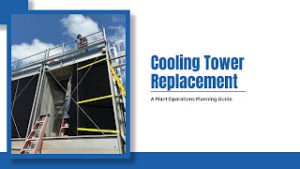
Why Cooling Tower Replacement Is an Operational Challenge, Not Just a Maintenance Task
Most facilities treat cooling tower replacement as a maintenance event. That framing causes problems.
Professional cooling tower replacement requires coordinated input from engineering, operations, procurement, maintenance, and contractors working from a single agreed plan. Projects that skip this coordination stage consistently run longer, cost more, and create avoidable production losses.
The sections below walk through each planning step in the sequence that experienced project teams use.
Step 1: Map What the Existing Cooling Tower Actually Supports
Identify Every Critical Cooling Load
Before setting a replacement date, the project team needs a complete picture of what depends on the existing tower. This is not a step to estimate—it requires verified data from operations and engineering.
Cooling loads that commonly depend on a single tower include:
- Production equipment: Process reactors, compressors, and manufacturing lines with defined temperature limits.
- Heat exchangers: Systems that rely on cooling water flow to maintain safe operating temperatures.
- HVAC and utility loads: Comfort cooling and facility systems that run continuously.
- Other temperature-sensitive equipment: Electrical rooms, control panels, and auxiliary systems.
Step 2: Determine How Much Downtime the Plant Can Actually Tolerate
Calculate the Available Shutdown Window
The acceptable outage window is not a guess—it should come from production scheduling, seasonal demand data, and existing maintenance calendars.
Factors that define a realistic window include:
- Planned maintenance shutdowns: Turnaround schedules already built into the production calendar.
- Seasonal demand patterns: Periods when production volumes are lower reduce the risk of cooling loss.
- Low-production windows: Weekends or shift-change periods that reduce cooling demand temporarily.
- Existing turnaround schedules: Aligning the cooling tower installation with a broader shutdown avoids creating a separate outage.
Define the Maximum Acceptable Cooling Tower Downtime
The contractor and the plant team need one agreed number before work starts. That number drives crane scheduling, crew sizing, pre-ordered materials, and contingency depth. Without it, the project lacks a firm target.
Step 3: Plan How Cooling Will Be Maintained During Replacement
This is the question that determines whether the project disrupts production or not. Several strategies exist, and the right choice depends on plant configuration and industrial cooling system layout.
Each strategy carries different cost, complexity, and lead-time requirements. The project team should evaluate all options before committing to one.
Possible continuity strategies include:
- Temporary cooling equipment: Portable chillers or rental cooling towers connected to the existing distribution system.
- Adjacent tower cells: Where multi-cell systems exist, redistributing load to remaining cells during replacement.
- Reducing non-critical loads: Temporarily suspending non-essential processes to lower total cooling demand.
- Staged replacement: Replacing individual tower cells sequentially so the system maintains partial capacity throughout.
- Scheduled shutdown alignment: Timing the replacement to coincide with a planned maintenance shutdown that already removes the process load.
No single strategy works for every site. The appropriate approach requires plant-specific engineering review.
Step 4: Complete as Much Work as Possible Before Shutdown Day
The goal of pre-shutdown preparation is to convert the shutdown window from a preparation period into a pure installation window. Every hour spent sourcing materials or confirming measurements during the outage extends cooling tower downtime unnecessarily.
Pre-shutdown activities that experienced teams complete in advance include:
- Engineering review: Confirming the replacement tower specifications match actual site loads and conditions.
- Foundation and structural assessment: Identifying any repairs needed before installation begins.
- Replacement tower selection and procurement: Finalizing equipment orders with lead times confirmed.
- Material staging: Delivering all components to site before the shutdown begins.
- Crane and access planning: Scheduling lifting equipment and confirming site access routes.
- Contractor coordination: Confirming crew availability, responsibilities, and sequence of work.
Facilities that complete this preparation consistently finish cooling tower installation faster and with fewer unplanned extensions.
Step 5: Build a Realistic Cooling Tower Project Timeline
A structured cooling tower project timeline prevents the most common source of project overruns: underestimating the time between phases.
The standard project sequence runs:
Engineering → Procurement → Site Preparation → Shutdown → Removal → Installation → Testing → Restart
Build Contingency Time Into Every Phase
Experienced project teams do not treat the baseline schedule as the final schedule. They identify the most likely delay sources and add buffer at each stage.
Common delay sources include:
- Material delivery: Long lead items for specialty components ordered without confirmed delivery dates.
- Crane availability: Lifting equipment schedules that conflict with other regional projects.
- Unexpected structural conditions: Foundation damage or deterioration found during site preparation.
- Existing piping or electrical issues: Conditions that require remediation before the new tower can connect.
- Weather: Outdoor work windows that shift due to wind or precipitation limits on crane operations.
Cooling Tower Replacement Strategy Comparison
Before reviewing the table, confirm your plant’s load profile and acceptable cooling tower downtime window. That information determines which options are realistically available.
| Strategy | Downtime Required | Cooling Continuity | Complexity | Best Suited For |
| Full shutdown replacement | Full outage window | None during replacement | Low | Plants with defined turnaround schedules |
| Staged cell replacement | Partial, per cell | Maintained at reduced capacity | Medium | Multi-cell towers with flexible load distribution |
| Temporary rental cooling | Minimal | Full capacity maintained | Medium–High | Critical continuous processes |
| Shutdown alignment | Zero additional outage | Maintained until planned shutdown | Low | Facilities with upcoming turnarounds |
| Load shedding + fast replacement | Short window | Non-critical loads suspended | Medium | Sites with separable critical and non-critical loads |
Step 6: Coordinate Every Team Before the Shutdown Begins
Cooling tower replacement projects rarely involve only the tower contractor. Missing even one team from the pre-shutdown coordination meeting creates gaps that appear at the worst possible moment—during the outage itself.
Teams that typically need direct involvement include:
- Plant operations: Process knowledge and shutdown sequencing authority.
- Maintenance: Isolation procedures, equipment history, and on-site support.
- Electrical teams: Motor disconnection, controls isolation, and reconnection.
- Piping contractors: Connection work, valve operation, and system integrity testing.
- Safety personnel: Permit-to-work approvals, confined space requirements, and crane safety.
- Cooling tower specialists: Installation sequence, technical specifications, and commissioning requirements.
Step 7: Execute the Replacement in a Controlled Sequence
Isolate and Prepare the Existing Tower
Safe execution starts with a verified isolation sequence. Rushing this step creates safety risks and can damage connected equipment.
- Confirm safe shutdown of the existing tower.
- Isolate water supply and return lines with confirmed valve positions.
- Complete electrical isolation and lockout/tagout procedures.
- Drain and prepare the basin and fill sections for removal.
Remove the Existing Equipment
Controlled dismantling protects surrounding equipment and the site access paths needed for installation. Controlled removal requires:
- Planned sequence for section removal to maintain structural stability.
- Site access management to keep crane paths clear throughout.
- Safe removal and disposal of fill, casing, and mechanical components.
Install the New Cooling Tower
For complex projects, cooling tower replacement support from experienced specialists reduces the risk of installation errors that create long-term performance problems.
Installation steps include:
- Structural positioning and alignment on the prepared foundation.
- Piping connections to the existing distribution system.
- Electrical and mechanical connections with verified specifications.
- Pre-startup alignment and system checks before water introduction.
Final Thoughts
Cooling tower replacement delivers reliable results when planning precedes execution by weeks or months, not days. Map cooling loads thoroughly. Define a realistic plant shutdown planning window. Arrange cooling continuity where the process demands it. Complete procurement, structural work, and contractor coordination before the outage begins.
The purpose of structured cooling tower replacement planning is not simply to install new equipment. The objective is to restore reliable cooling system reliability within the shortest practical window—protecting production, protecting connected equipment, and protecting the plant’s ability to restart on schedule.
Frequently Asked Questions
How long does a cooling tower replacement take?
Cooling tower replacement timelines vary based on tower size, site access, and cooling tower installation complexity. Small to mid-size towers typically require 1–3 weeks from shutdown to restart. Larger or more complex systems may require 4–8 weeks. Pre-shutdown preparation—procurement, foundation work, and contractor coordination—can take 8–16 weeks before the outage begins.
Can a cooling tower be replaced without shutting down the entire plant?
Yes, in many cases. Strategies such as staged cell replacement, temporary rental cooling equipment, or load shedding on non-critical processes can maintain partial or full industrial cooling system capacity during replacement. The right approach depends on plant configuration, cooling load criticality, and available budget for interim cooling.
When is the best time to schedule cooling tower replacement?
The best timing aligns with existing planned maintenance shutdown windows or seasonal periods when production demand is lower. Scheduling during an existing turnaround avoids creating a separate outage and typically reduces total project cost.
Avoid scheduling during peak production seasons when cooling tower downtime risk carries the highest operational consequence.
Source: FG Newswire