When comparing Real Fonts vs Unicode Fonts, many people assume they’re the same. Both can transform ordinary text into something more visually appealing, but they work in completely different ways.
Knowing how each one functions can help you choose the right option, whether you’re designing a website, creating a logo, or generating Letras Bonitas for your Instagram bio, TikTok profile, Discord username, or other social media platforms.
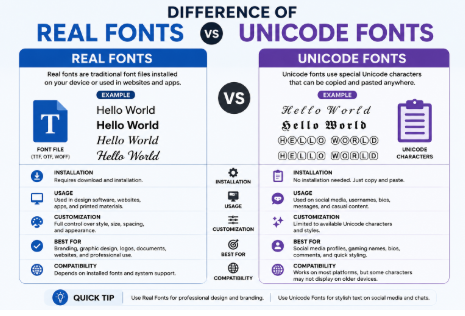
Real fonts are traditional font files installed on a device or embedded into a website, making them the preferred choice for graphic design, branding, and printed materials. Unicode fonts, on the other hand, are decorative Unicode characters that can be copied and pasted across many websites and apps without downloading or installing anything.
What Are Real Fonts?
Real fonts are digital typeface files that determine how letters, numbers, punctuation marks, and symbols appear on a screen or in print. They are installed on a computer, smartphone, or server and are loaded by software whenever text needs to be displayed.
Popular examples include:
- Arial
- Helvetica
- Calibri
- Roboto
- Times New Roman
- Open Sans
These fonts are widely used in websites, mobile applications, books, presentations, logos, advertisements, and printed documents.
Unlike Unicode text, real fonts don’t change the characters themselves. They simply change how those characters are rendered.
What Are Unicode Fonts?
Although the phrase Unicode Fonts is commonly used, it isn’t technically accurate.
Unicode fonts are actually Unicode characters that resemble decorative or stylized letters. Instead of applying a different font file, a Unicode text generator replaces each standard letter with another character from the Unicode Standard.
For example:
Normal Text
- Hello World
Unicode Text
- 𝓗𝓮𝓵𝓵𝓸 𝓦𝓸𝓻𝓵𝓭
- 𝗛𝗲𝗹𝗹𝗼 𝗪𝗼𝗿𝗹𝗱
- 𝕳𝖊𝖑𝖑𝖔 𝖂𝖔𝖗𝖑𝖉
Because these are actual Unicode characters, they can usually be copied and pasted directly into social media platforms, messaging apps, online communities, and gaming profiles.
How Do Real Fonts Work?
Real fonts are stored as font files, including:
- TrueType Fonts (TTF)
- OpenType Fonts (OTF)
- Web Open Font Format (WOFF)
- WOFF2
When a document or website specifies a font, the operating system or browser loads the appropriate font file and displays the text using that typeface.
If the requested font isn’t available, the system automatically substitutes another compatible font.
How Do Unicode Fonts Work?
Unicode is an international standard that assigns a unique code point to every supported character.
Unicode text generators don’t create new fonts. Instead, they replace ordinary letters with decorative Unicode symbols that already exist within the Unicode Standard.
Since these symbols are recognized by modern operating systems and browsers, they can usually be displayed consistently without installing additional software.
Real Fonts vs Unicode Fonts
| Feature | Real Fonts | Unicode Fonts |
| Installation Required | Yes | No |
| Uses Font Files | Yes | No |
| Copy and Paste | No | Yes |
| Works in Graphic Design Software | Yes | Limited |
| Best for Websites | Yes | Limited |
| Best for Social Media | Limited | Excellent |
| Editable as Text | Yes | Yes |
| Best Use | Design, branding, printing | Social media, usernames, messaging |
Advantages of Real Fonts
Real fonts remain the standard choice for professional typography because they provide complete control over text appearance.
Some of their biggest advantages include:
- Professional typography
- Multiple font weights and styles
- Excellent readability
- Precise spacing and alignment
- Ideal for branding projects
- High-quality printing
- Better consistency across design software
For websites and graphic design projects, real fonts provide flexibility that Unicode characters cannot replace.
Advantages of Unicode Fonts
Unicode text has become increasingly popular because it’s simple, accessible, and works across many platforms.
Its benefits include:
- No installation required
- Instant copy-and-paste functionality
- Compatible with most modern devices
- Great for social media profiles
- Perfect for gaming usernames
- Easy to generate online
- Ideal for personalizing messages and bios
These advantages make Unicode text an excellent choice for anyone looking to add personality to their online presence.
When Should You Use Real Fonts?
Real fonts are the best option whenever typography and visual consistency are important.
Use them for:
- Websites
- Mobile applications
- Company branding
- Logos
- Books
- Printed materials
- Presentations
- Marketing campaigns
- Graphic design projects
If you’re creating professional visual content, traditional font files are the right solution.
When Should You Use Unicode Fonts?
Unicode text is ideal whenever you need stylish text that can be copied and pasted instantly.
Common uses include:
- Instagram bios
- TikTok profiles
- Discord usernames
- WhatsApp status updates
- Facebook posts
- X (Twitter) display names
- Gaming nicknames
- YouTube channel names
Because Unicode text doesn’t require installation, it’s one of the fastest ways to personalize online content.
Are Unicode Fonts Compatible Everywhere?
Most modern operating systems, browsers, and social media platforms support a large portion of Unicode characters.
However, compatibility isn’t identical everywhere.
Some older devices or websites may:
- Display empty boxes
- Replace unsupported symbols
- Show standard characters instead
Testing your text before publishing is always recommended, especially if it will be viewed on multiple platforms.
Which Option Should You Choose?
Choosing between real fonts and Unicode fonts depends entirely on your goal.
If you’re building a website, designing a logo, publishing a book, or creating marketing materials, real fonts provide the flexibility and precision you need.
If you’re updating an Instagram bio, creating a gaming username, or making your social media profile more distinctive, Unicode text offers a quick and convenient solution without requiring any downloads.
Rather than competing with each other, these two technologies complement one another. Many designers use real fonts for professional work while relying on Unicode text to personalize their online presence.
Frequently Asked Questions
What is the difference between Real Fonts and Unicode Fonts?
Real fonts are downloadable font files that control how text is displayed, while Unicode fonts use decorative Unicode characters that can be copied and pasted without installing additional software.
Are Unicode Fonts real fonts?
No. Despite the name, Unicode fonts are not actual font files. They are alternative Unicode characters that resemble different lettering styles.
Do I need to install Unicode Fonts?
No. Unicode text works without downloading or installing anything. You simply generate the text, copy it, and paste it into supported platforms.
Which is better for Instagram: Real Fonts or Unicode Fonts?
Unicode fonts are generally the better choice for Instagram because they work in bios, usernames, captions, and comments through simple copy-and-paste functionality.
Can I use Real Fonts on websites?
Yes. Real fonts are specifically designed for websites, applications, branding, and printed materials, providing consistent typography and professional design control.
Can Unicode Fonts improve SEO?
No. Unicode characters don’t directly influence search rankings. Strong content, relevant keywords, page speed, and user experience remain the key factors for SEO success.
Can I use both Real Fonts and Unicode Fonts together?
Yes. Many creators use real fonts for websites and graphic design while using Unicode text for social media profiles, gaming usernames, and online communities.
Final Thoughts
The comparison between Real Fonts vs Unicode Fonts isn’t about deciding which one is better—it’s about understanding where each one performs best. Real fonts provide the foundation for professional typography, branding, websites, and printed materials, while Unicode fonts offer a simple way to create stylish copy-and-paste text for social media, messaging apps, and gaming platforms.
By understanding the strengths of both, you can choose the right solution for every project and create content that’s both visually appealing and appropriate for its intended audience.
Source: FG Newswire