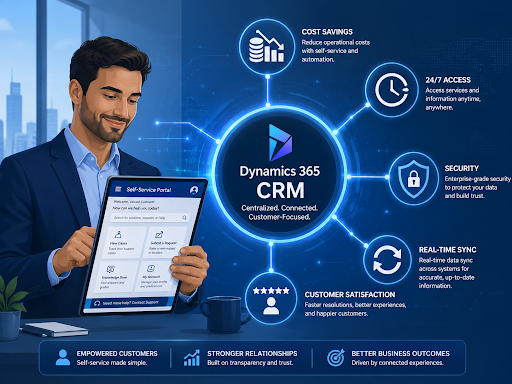
The cost of answering a routine customer question keeps climbing, and most of those questions never needed a human in the first place. Industry research has consistently shown that the majority of customers prefer to help themselves before contacting a company, and that a phone call costs a business far more to handle than a self-service interaction. For organizations running Microsoft Dynamics 365, a customer portal is the most direct way to act on both of those facts at once.
A Dynamics 365 customer portal is a secure online space linked to your CRM, where customers can find information, raise and track requests, view their records, and complete transactions on their own. Because it connects to the data already living in Dynamics 365, it does this without creating a second system for your team to maintain. The benefits show up quickly, and they compound over time.
Lower Support Costs and Fewer Repetitive Tickets
The most immediate benefit is a smaller support burden. When customers can check an order status, download an invoice, or read a help article themselves, those interactions never become tickets. Support agents are freed from answering the same handful of questions dozens of times a week and can focus on the complex issues that genuinely need their expertise.
The effect is not just lower cost. It also tends to improve the quality of support, because a team that is not buried in routine requests has the time to handle harder problems properly. For many businesses, this shift alone pays for the portal.
True 24/7 Self-Service
Your support team works set hours. Your customers do not. A portal gives people a way to get things done at midnight, on a weekend, or across time zones, without waiting for an office to open.
This matters most for the small but constant stream of tasks that customers want to handle the moment they think of them, such as updating account details, submitting a request, or checking where something stands. Round-the-clock availability removes the frustration of waiting and signals that the business respects the customer’s time, which is a meaningful contributor to loyalty.
Real-Time Access to Dynamics 365 Data
A portal is only useful if the information inside it is current. A well-built Dynamics 365 customer portal syncs with Dataverse in real time, so when a record changes in the CRM the customer sees the update right away, and when a customer takes an action in the portal it flows straight back into Dynamics 365.
This eliminates the delays and errors that come from manual data entry or overnight syncs. Customers trust what they see, agents work from the same live information, and nobody wastes time reconciling two versions of the same record. A single, accurate source of truth is one of the quieter but more valuable benefits a portal delivers.
A Better Customer Experience That Drives Retention
Self-service done well is not a downgrade from human support. It is often what customers actively prefer. Giving people a clean, personalized space where they can see their own orders, cases, documents, and account history makes the relationship feel transparent and in their control.
That experience has a direct line to retention. Customers who can easily get what they need are far more likely to stay and to buy again. A portal that surfaces the right information at the right moment turns routine interactions into reasons to keep doing business with you rather than reasons to look elsewhere.
Less Manual Work for Your Team
Every time a staff member emails an invoice, copies data between systems, or chases an internal approval on a customer’s behalf, that is time spent on work the customer could have completed themselves. A portal automates these handoffs.
Requests can trigger workflows in Dynamics 365 automatically, documents are available without anyone fetching them, and updates move between customer and CRM without a person in the middle. The result is a leaner operation where staff spend their hours on work that actually requires judgment, not on shuffling information from one place to another.
Stronger Security and Compliance
Handing customers access to their own data raises an obvious question about safety, and a serious portal answers it directly. Role-based access control ensures each user sees only what they are permitted to see, while single sign-on, multi-factor authentication, and encryption protect the data in transit and at rest.
For businesses in regulated fields such as finance, healthcare, or insurance, this is not optional. A portal built on certified, secure infrastructure lets these organizations extend self-service to customers without taking on unacceptable risk, and the better platforms treat security as a standard rather than a premium add-on.
Room to Scale Without Runaway Costs
As a business grows, so does its customer base, and some portal options charge more for every additional user or login. That model can turn a successful portal into an expensive liability precisely when it is working best.
This is why pricing structure deserves attention during any evaluation. Platforms like CRMJetty’s Dynamics 365 Customer Portal use a flat-fee model rather than per-user charges, which means a company can grow its user base without watching license costs climb in lockstep. The broader point is to choose an approach that rewards growth instead of penalizing it.
Making the Most of the Investment
The benefits above reinforce one another. Lower support costs free up the team, real-time data builds trust, a strong experience drives retention, and sensible pricing keeps the whole thing sustainable as you scale. To capture them, focus less on the longest feature list and more on the fundamentals that customers actually feel, namely accurate data, genuine self-service, dependable security, and a design people are happy to use.
A Dynamics 365 customer portal is not simply a place for customers to log in. Treated as a core part of the customer experience rather than an afterthought, it becomes one of the most cost-effective ways a business has to serve people well and keep them coming back.
Source: FG Newswire